颠 (diān) means "Top; to jolt; to fall" in Chinese. It has 16 strokes with the radical 页, and is HSK Level 7.
Rated 4.2/5 in difficulty (advanced).
Harder than 98% of HSK Level 7 characters.
Appears in 3+ common words including 颠倒 (diān dǎo), 颠簸 (diān bǒ), 颠覆 (diān fù).
Due to its 16 strokes, Hanzi Writer's error detection shows 颠 requires focused practice — most learners need 10+ attempts for consistent accuracy.
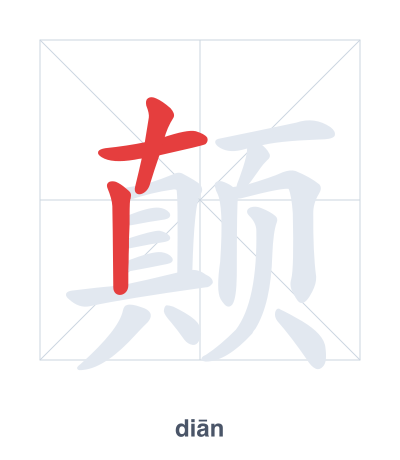
Open Hanzi Writer to see the animated stroke order and practice writing 颠 with real-time feedback.
The character 颠 (diān) is written with 16 strokes. Follow the standard Chinese stroke order: top to bottom, left to right, outside before inside. The radical 页 is one of its key components.
Practice the correct stroke order with the Hanzi Writer app to see animated stroke-by-stroke guidance with real-time feedback.
颠 means Top; to jolt; to fall.
As an HSK Level 7 character, 颠 is an intermediate-level character.
颠 is a compound character with the radical 页 (head) and phonetic component 真 (true/real). The original meaning was 'top of the head,' which later extended to 'top' in general, and from the head's motion came 'to jolt' and 'to fall.'
💡 Memory Tip: A true (真) head (页) sits at the top until it gets jolted and falls down with a crash.
你的衣服穿颠倒了。
nǐ de yī fú chuān diān dǎo le
You've put your clothes on backwards.
路很平,不颠簸。
lù hěn píng bù diān bǒ
The road is very flat and not bumpy.
这个想法颠覆了传统。
zhè ge xiǎng fǎ diān fù le chuán tǒng
This idea subverts tradition.
Open Hanzi Writer to see the animated stroke order and practice writing 颠 with real-time feedback.
✨ Animated stroke order · Handwriting recognition · HSK-graded practice · Free to use
颠 is composed of the left component 真 (zhēn, meaning 'true') and the right radical 页 (yè, meaning 'head' or 'top'). The 页 radical indicates the character relates to the head or top, while 真 provides the approximate pronunciation diān. The original meaning was 'top of the head', which later extended to 'to fall headfirst' and 'to jolt'.