颚 (è) means "jaw / palate" in Chinese. It has 15 strokes with the radical 页.
Rated 4.2/5 in difficulty (advanced).
Appears in 3+ common words including 下颚 (xià è), 上颚 (shàng è), 颚骨 (è gǔ).
Due to its 15 strokes, Hanzi Writer's error detection shows 颚 requires focused practice — most learners need 10+ attempts for consistent accuracy.
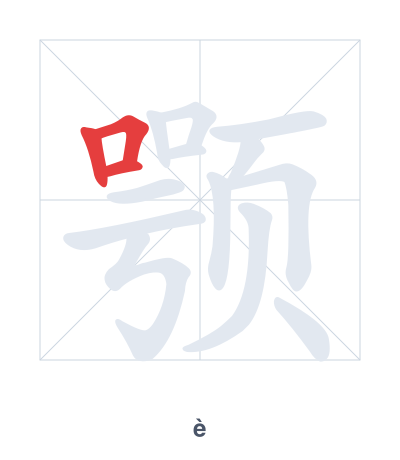
Open Hanzi Writer to see the animated stroke order and practice writing 颚 with real-time feedback.
The character 颚 (è) is written with 15 strokes. Follow the standard Chinese stroke order: top to bottom, left to right, outside before inside. The radical 页 is one of its key components.
Practice the correct stroke order with the Hanzi Writer app to see animated stroke-by-stroke guidance with real-time feedback.
颚 means jaw / palate.
颚 is a phono-semantic compound. The radical 页 (head/face) indicates the meaning relates to the head, while the right component 咢 (è) provides the sound. The jaw and palate are key parts of the head's structure, linking the visual form to the meaning.
💡 Memory Tip: Picture a head (页) with a jaw that opens like an 'e' shape (咢) to say 'ah' as you bite down.
他的下颚有点疼。
tā de xià è yǒu diǎn téng
His lower jaw hurts a bit.
舌头轻轻抵住上颚。
shé tou qīng qīng dǐ zhù shàng è
The tongue lightly touches the upper palate.
医生检查了他的颚骨。
yī shēng jiǎn chá le tā de è gǔ
The doctor examined his jawbone.
Open Hanzi Writer to see the animated stroke order and practice writing 颚 with real-time feedback.
✨ Animated stroke order · Handwriting recognition · HSK-graded practice · Free to use
The character 颚 is made of two parts: the left part 口 (mouth) and the right part 页 (head or page). Together they suggest a part of the head connected to the mouth, which is the jaw or palate. This structure is common in characters for body parts related to the head.