醇 (chún) means "mellow or pure" in Chinese. It has 15 strokes with the radical 酉, and is HSK Level 7.
Rated 4.2/5 in difficulty (advanced).
Harder than 94% of HSK Level 7 characters.
Appears in 3+ common words including 醇厚 (chún hòu), 醇香 (chún xiāng), 乙醇 (yǐ chún).
Due to its 15 strokes, Hanzi Writer's error detection shows 醇 requires focused practice — most learners need 10+ attempts for consistent accuracy.
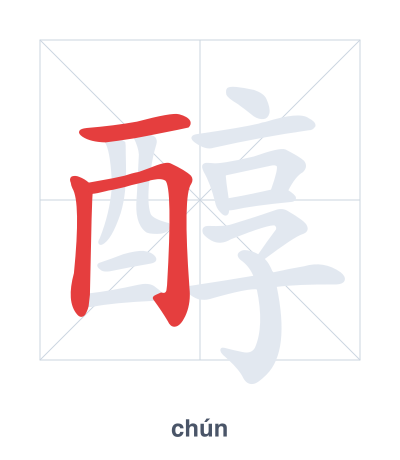
Open Hanzi Writer to see the animated stroke order and practice writing 醇 with real-time feedback.
The character 醇 (chún) is written with 15 strokes. Follow the standard Chinese stroke order: top to bottom, left to right, outside before inside. The radical 酉 is one of its key components.
Practice the correct stroke order with the Hanzi Writer app to see animated stroke-by-stroke guidance with real-time feedback.
醇 means mellow or pure.
As an HSK Level 7 character, 醇 is an intermediate-level character.
醇 combines 酉 (wine jar) with 享 (to offer/feast); originally it meant unadulterated wine offered at ceremonies, hence 'pure' and 'mellow'. The wine jar component sets the context of alcoholic drink, while 享 hints at the high quality reserved for ritual use.
💡 Memory Tip: Imagine a wine jar (酉) with a special lid that has a cross (享) on it, guaranteeing the wine inside is pure and mellow.
这酒的味道很醇厚。
zhè jiǔ de wèi dào hěn chún hòu
This wine has a rich and mellow taste.
咖啡散发出醇香。
kā fēi sàn fà chū chún xiāng
The coffee gives off a mellow aroma.
乙醇可以用来消毒。
yǐ chún kě yǐ yòng lái xiāo dú
Ethanol can be used for disinfection.
Open Hanzi Writer to see the animated stroke order and practice writing 醇 with real-time feedback.
✨ Animated stroke order · Handwriting recognition · HSK-graded practice · Free to use
醇 is composed of the radical 酉 (meaning wine or alcohol) on the left, and the phonetic component 享 on the right. The 酉 ties the character to alcoholic drinks, while 享 hints at the pronunciation chún. Together, they suggest the idea of "mellow wine" or a pure, rich flavor.