乙 (yǐ) means "second; 'B' (in a sequence); ethyl" in Chinese. It has 1 strokes with the radical 乙, and is HSK Level 5.
Rated 1.7/5 in difficulty (beginner-friendly).
Harder than 0% of HSK Level 5 characters.
Appears in 3+ common words including 乙方 (yǐ fāng), 乙级 (yǐ jí), 甲乙 (jiǎ yǐ).
In the Hanzi Writer app, most learners master 乙 within 3 practice attempts using stroke-by-stroke animation.
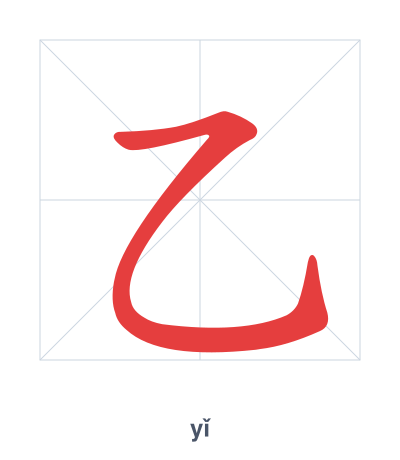
Open Hanzi Writer to see the animated stroke order and practice writing 乙 with real-time feedback.
The character 乙 (yǐ) is written with 1 stroke. Follow the standard Chinese stroke order: top to bottom, left to right, outside before inside. The radical 乙 is one of its key components.
Practice the correct stroke order with the Hanzi Writer app to see animated stroke-by-stroke guidance with real-time feedback.
乙 means second; 'B' (in a sequence); ethyl.
As an HSK Level 5 character, 乙 is an intermediate-level character.
| Character | 乙 |
| Pinyin | yǐ (yi) |
| Meaning | second; 'B' (in a sequence); ethyl |
| Strokes | 1 |
| Radical | 乙 |
| HSK Level | 5 |
| Difficulty | 1.7/5 |
Ancient 乙 (yǐ) was a pictograph of a fish's gut or a twisting line, representing the second of the ten heavenly stems in the Chinese cyclical calendar. Its curved, simplified form came to denote 'second' or 'B' in sequences, as well as the ethyl group in chemistry.
💡 Memory Tip: Picture a bent fishhook that catches the second fish in line.
乙方已经签了合同。
yǐ fāng yǐ jīng qiān le hé tóng
Party B has already signed the contract.
这是乙级足球联赛。
zhè shì yǐ jí zú qiú lián sài
This is the B-level football league.
甲乙两队正在比赛。
jiǎ yǐ liǎng duì zhèng zài bǐ sài
Teams A and B are competing.
Open Hanzi Writer to see the animated stroke order and practice writing 乙 with real-time feedback.
✨ Animated stroke order · Handwriting recognition · HSK-graded practice · Free to use
乙 is a single-stroke character with no separable components; it is a simple curved line. Its meaning as 'second' comes from its ancient use as a numeral in a sequence, similar to 'B' in English. The character itself does not contain radicals or phonetic parts, focusing purely on its symbolic role as a marker of order.