裁 (cái) means "To cut (cloth/paper); to reduce; to judge" in Chinese. It has 12 strokes with the radical 衣, and is HSK Level 5.
Rated 4.2/5 in difficulty (advanced).
Harder than 92% of HSK Level 5 characters.
Appears in 3+ common words including 裁判 (cái pàn), 裁剪 (cái jiǎn), 裁员 (cái yuán).
Due to its 12 strokes, Hanzi Writer's error detection shows 裁 requires focused practice — most learners need 10+ attempts for consistent accuracy.
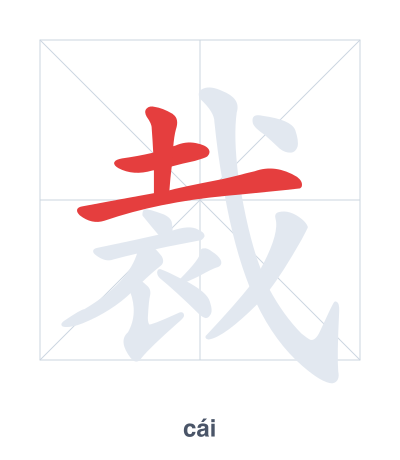
Open Hanzi Writer to see the animated stroke order and practice writing 裁 with real-time feedback.
The character 裁 (cái) is written with 12 strokes. Follow the standard Chinese stroke order: top to bottom, left to right, outside before inside. The radical 衣 is one of its key components.
Practice the correct stroke order with the Hanzi Writer app to see animated stroke-by-stroke guidance with real-time feedback.
裁 means To cut (cloth/paper); to reduce; to judge.
As an HSK Level 5 character, 裁 is an intermediate-level character.
The character 裁 combines the clothing radical 衣 on the left, representing fabric, with 戈 (dagger-axe) and 木 (wood) on the right, evoking the image of cutting cloth on a wooden board with a blade. This reflects its original meaning of cutting fabric for tailoring.
💡 Memory Tip: Imagine a tailor using an axe-like blade on a wooden board to cut a piece of cloth (衣) — that’s 裁.
裁判吹了哨子。
cái pàn chuī le shào zi
The referee blew the whistle.
她在裁剪布料。
tā zài cái jiǎn bù liào
She is cutting the fabric.
公司决定裁员。
gōng sī jué dìng cái yuán
The company decided to lay off staff.
Open Hanzi Writer to see the animated stroke order and practice writing 裁 with real-time feedback.
✨ Animated stroke order · Handwriting recognition · HSK-graded practice · Free to use
裁 combines the component 衣 (clothing) on the bottom and 䒑 (which originally relates to cutting) on top. The idea is that you cut clothing material, which connects to its meanings of cutting cloth, reducing, or judging.