判 (pàn) means "judge / sentence / distinguish" in Chinese. It has 7 strokes with the radical 刂, and is HSK Level 3.
Rated 3.2/5 in difficulty (challenging).
Harder than 28% of HSK Level 3 characters.
Appears in 3+ common words including 判断 (pàn duàn), 谈判 (tán pàn), 裁判 (cái pàn).
Due to its 7 strokes, Hanzi Writer's error detection shows 判 requires focused practice — most learners need 10+ attempts for consistent accuracy.
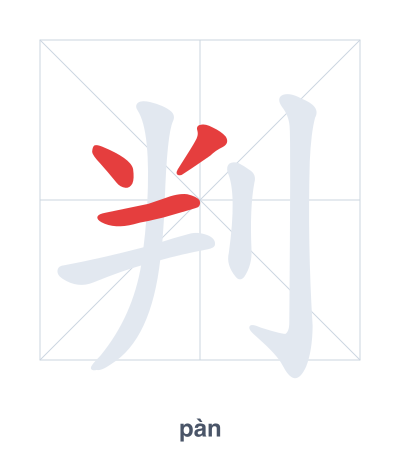
Open Hanzi Writer to see the animated stroke order and practice writing 判 with real-time feedback.
The character 判 (pàn) is written with 7 strokes. Follow the standard Chinese stroke order: top to bottom, left to right, outside before inside. The radical 刂 is one of its key components.
Practice the correct stroke order with the Hanzi Writer app to see animated stroke-by-stroke guidance with real-time feedback.
判 means judge / sentence / distinguish.
As an HSK Level 3 character, 判 is an intermediate-level character.
判 combines 半 (half) and 刂 (knife), originally meaning to cut something in half. This act of dividing became a metaphor for making a judgment or distinguishing between options, like a judge cutting through a case to reach a verdict.
💡 Memory Tip: A judge uses a knife (刂) to split a case (半) in half, deciding which side wins.
你的判断完全正确。
nǐ de pàn duàn wán quán zhèng què
Your judgment is completely correct.
双方正在进行谈判。
shuāng fāng zhèng zài jìn xíng tán pàn
Both sides are currently in negotiations.
裁判非常公平。
cái pàn fēi cháng gōng píng
The referee is very fair.
Open Hanzi Writer to see the animated stroke order and practice writing 判 with real-time feedback.
✨ Animated stroke order · Handwriting recognition · HSK-graded practice · Free to use
判 is made of two parts: 半 on the left meaning "half" and 刂 on the right, the knife radical. Together they suggest cutting something in half, which relates to making a decision or judgment. This structure also links to the idea of distinguishing or separating right from wrong.