衰 (shuāi) means "to decline; to wane; to weaken" in Chinese. It has 10 strokes with the radical 衣, and is HSK Level 7.
Rated 4.2/5 in difficulty (advanced).
Harder than 89% of HSK Level 7 characters.
Appears in 3+ common words including 衰老 (shuāi lǎo), 衰退 (shuāi tuì), 衰弱 (shuāi ruò).
Due to its 10 strokes, Hanzi Writer's error detection shows 衰 requires focused practice — most learners need 10+ attempts for consistent accuracy.
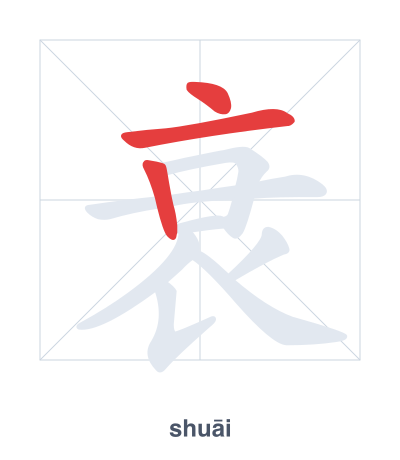
Open Hanzi Writer to see the animated stroke order and practice writing 衰 with real-time feedback.
The character 衰 (shuāi) is written with 10 strokes. Follow the standard Chinese stroke order: top to bottom, left to right, outside before inside. The radical 衣 is one of its key components.
Practice the correct stroke order with the Hanzi Writer app to see animated stroke-by-stroke guidance with real-time feedback.
衰 means to decline; to wane; to weaken.
As an HSK Level 7 character, 衰 is an intermediate-level character.
衰 originally depicted a straw raincoat (top part resembling the cape) worn over clothing (衣). Over time, the coarse, fragile material symbolized things wearing out or weakening, leading to the meaning 'to decline' or 'to wane'.
💡 Memory Tip: Imagine a coat (衣) with a giant crack or split (like the top part) causing it to fall apart and decline in quality.
每个人都会衰老。
měi gè rén dū huì shuāi lǎo
Everyone will grow old.
经济开始衰退了。
jīng jì kāi shǐ shuāi tuì le
The economy has started to decline.
他的身体很衰弱。
tā de shēn tǐ hěn shuāi ruò
His body is very feeble.
Open Hanzi Writer to see the animated stroke order and practice writing 衰 with real-time feedback.
✨ Animated stroke order · Handwriting recognition · HSK-graded practice · Free to use
衰 combines the radical 衣 (clothing) on the outside and a phonetic component 口 (mouth) inside, but the meaning 'to decline' comes from ancient imagery of a garment wearing thin or decaying. The radical 衣 suggests something covering or worn, while the overall shape hints at deterioration over time.