员 (yuán) means "member / personnel" in Chinese. It has 7 strokes with the radical 口, and is HSK Level 3.
Rated 3.5/5 in difficulty (challenging).
Harder than 37% of HSK Level 3 characters.
Appears in 3+ common words including 员工 (yuán gōng), 服务员 (fú wù yuán), 队员 (duì yuán).
Due to its 7 strokes, Hanzi Writer's error detection shows 员 requires focused practice — most learners need 10+ attempts for consistent accuracy.
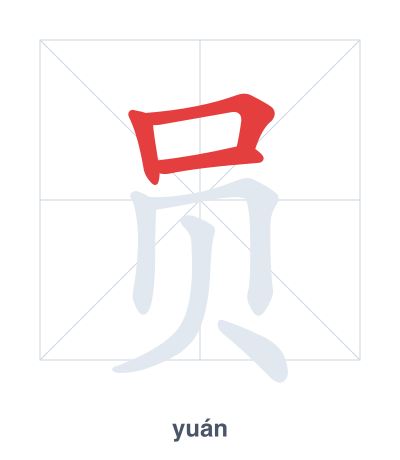
Open Hanzi Writer to see the animated stroke order and practice writing 员 with real-time feedback.
The character 员 (yuán) is written with 7 strokes. Follow the standard Chinese stroke order: top to bottom, left to right, outside before inside. The radical 口 is one of its key components.
Practice the correct stroke order with the Hanzi Writer app to see animated stroke-by-stroke guidance with real-time feedback.
员 means member / personnel.
As an HSK Level 3 character, 员 is an intermediate-level character.
Originally a pictograph of a round vessel, 员 was borrowed to mean 'member' or 'personnel.' Its modern form combines 口 (mouth/opening) and 贝 (shell, a form of currency), symbolizing a person who communicates and contributes value within a group.
💡 Memory Tip: Picture a team member with a round head (口) wearing a shell badge (贝) — they're officially counted as personnel.
他是这里的员工。
tā shì zhè lǐ de yuán gōng
He is an employee here.
服务员,请点菜。
fú wù yuán qǐng diǎn cài
Waiter, we'd like to order, please.
他是足球队队员。
tā shì zú qiú duì duì yuán
He is a member of the soccer team.
Open Hanzi Writer to see the animated stroke order and practice writing 员 with real-time feedback.
✨ Animated stroke order · Handwriting recognition · HSK-graded practice · Free to use
The character 员 combines the radical 口 (mouth) on the top and 贝 (shell/money) on the bottom. Historically, 口 represents a person or a count, and 贝 represents wealth or value, so together they suggest a person who counts or manages resources—hence a 'member' or 'personnel'.