傲 (ào) means "proud; arrogant" in Chinese. It has 12 strokes with the radical 亻, and is HSK Level 6.
Rated 3.9/5 in difficulty (challenging).
Harder than 39% of HSK Level 6 characters.
Appears in 3+ common words including 骄傲 (jiāo ào), 傲慢 (ào màn), 傲气 (ào qì).
Due to its 12 strokes, Hanzi Writer's error detection shows 傲 requires focused practice — most learners need 10+ attempts for consistent accuracy.
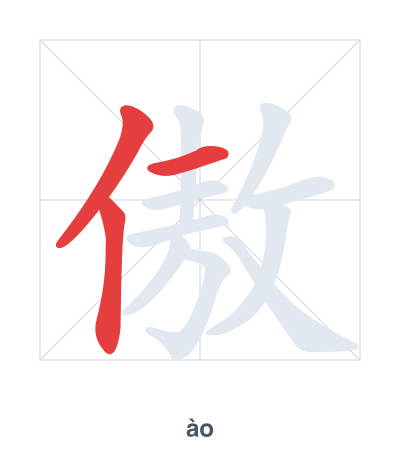
Open Hanzi Writer to see the animated stroke order and practice writing 傲 with real-time feedback.
The character 傲 (ào) is written with 12 strokes. Follow the standard Chinese stroke order: top to bottom, left to right, outside before inside. The radical 亻 is one of its key components.
Practice the correct stroke order with the Hanzi Writer app to see animated stroke-by-stroke guidance with real-time feedback.
傲 means proud; arrogant.
As an HSK Level 6 character, 傲 is an intermediate-level character.
傲 combines the person radical 亻 with 敖, which originally depicted a person wearing a headdress and a stick, suggesting a strutting wanderer. The compound implies someone who holds themselves aloft with exaggerated self-importance, hence 'proud' or 'arrogant'.
💡 Memory Tip: Picture a person (亻) standing on a mound of earth (土) while receiving applause (攵) — they are so proud they think they're 'all' that.
父母为他感到骄傲。
fù mǔ wèi tā gǎn dào jiāo ào
His parents are proud of him.
他的态度很傲慢。
tā de tài dù hěn ào màn
His attitude is very arrogant.
这个人很有傲气。
zhè ge rén hěn yǒu ào qì
This person is very arrogant.
Open Hanzi Writer to see the animated stroke order and practice writing 傲 with real-time feedback.
✨ Animated stroke order · Handwriting recognition · HSK-graded practice · Free to use
傲 is made of the radical 亻 (person) on the left, and 敖 (áo) on the right. 亻 shows that the meaning involves a person's attitude, while 敖 contributes the sound and also carries a sense of being unruly or dominant, together forming the idea of a proud or arrogant person.