六 (liù) means "Six" in Chinese. It has 4 strokes with the radical 八, and is HSK Level 1.
Rated 1.9/5 in difficulty (beginner-friendly).
Harder than 14% of HSK Level 1 characters.
Appears in 3+ common words including 六月 (liù yuè), 六个 (liù gè), 六点 (liù diǎn).
In the Hanzi Writer app, most learners master 六 within 3 practice attempts using stroke-by-stroke animation.
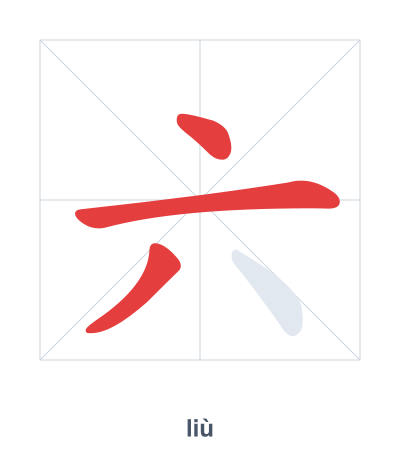
Open Hanzi Writer to see the animated stroke order and practice writing 六 with real-time feedback.
The character 六 (liù) is written with 4 strokes. Follow the standard Chinese stroke order: top to bottom, left to right, outside before inside. The radical 八 is one of its key components.
Practice the correct stroke order with the Hanzi Writer app to see animated stroke-by-stroke guidance with real-time feedback.
六 means Six.
As an HSK Level 1 character, 六 is among the first characters beginners learn.
In ancient oracle bone script, 六 depicted a simple hut or shelter, with a roof (the top horizontal stroke) and two sloping walls (the component 八, which originally meant 'to part' or 'two sides'). This pictograph was later borrowed phonetically to represent the number six, as the original word for 'hut' was no longer needed.
💡 Memory Tip: Imagine a small tent (top line and two sloping lines) where you and five friends huddle together—six people inside.
我六月去中国。
wǒ liù yuè qù zhōng guó
I'm going to China in June.
这里有六个苹果。
zhè lǐ yǒu liù gè píng guǒ
There are six apples here.
我们六点见。
wǒ men liù diǎn jiàn
See you at six.
Open Hanzi Writer to see the animated stroke order and practice writing 六 with real-time feedback.
✨ Animated stroke order · Handwriting recognition · HSK-graded practice · Free to use
六 is built from a dot and a horizontal line on top, plus two strokes below that form a shape like the radical 八 (eight). The bottom part does not directly mean 'six' but the overall character is a unique symbol for the number six.