多 (duō) means "Many, much, or more." in Chinese. It has 6 strokes with the radical 夕, and is HSK Level 1.
Rated 2.7/5 in difficulty (moderate).
Harder than 42% of HSK Level 1 characters.
Appears in 3+ common words including 多少 (duō shǎo), 很多 (hěn duō), 多久 (duō jiǔ).
Hanzi Writer's stroke validation shows learners typically need 5-8 attempts to write 多 with correct proportion and order.
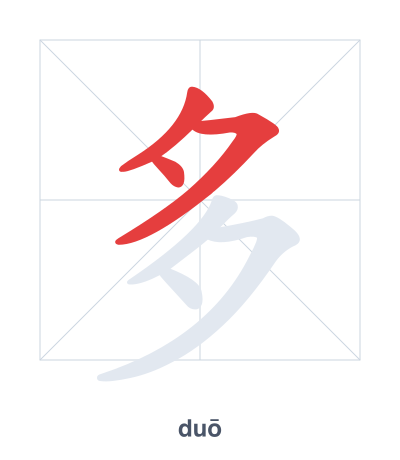
Open Hanzi Writer to see the animated stroke order and practice writing 多 with real-time feedback.
The character 多 (duō) is written with 6 strokes. Follow the standard Chinese stroke order: top to bottom, left to right, outside before inside. The radical 夕 is one of its key components.
Practice the correct stroke order with the Hanzi Writer app to see animated stroke-by-stroke guidance with real-time feedback.
多 means Many, much, or more..
As an HSK Level 1 character, 多 is among the first characters beginners learn.
The character 多 originally showed two pieces of meat (夕, a simplified form of 肉) stacked one on top of the other, suggesting abundance or a large quantity. Over time, the meaning generalized from 'a lot of meat' to simply 'many, much, or more.'
💡 Memory Tip: Imagine two slices of meat (夕) piled high on a plate — that's a lot of food, so 'many' (多)!
这个苹果多少钱?
zhè ge píng guǒ duō shǎo qián
How much is this apple?
公园里有很多人。
gōng yuán lǐ yǒu hěn duō rén
There are many people in the park.
你要去北京多久?
nǐ yào qù běi jīng duō jiǔ
How long are you going to Beijing for?
Open Hanzi Writer to see the animated stroke order and practice writing 多 with real-time feedback.
✨ Animated stroke order · Handwriting recognition · HSK-graded practice · Free to use
The character 多 is made by stacking two copies of the radical 夕 (evening) on top of each other. By repeating the same component, the structure visually suggests 'more than one' or 'many', which directly conveys the meaning of 'many' or 'much'.