捉 (zhuō) means "to catch" in Chinese. It has 10 strokes with the radical 扌, and is HSK Level 6.
Rated 4.2/5 in difficulty (advanced).
Harder than 63% of HSK Level 6 characters.
Appears in 3+ common words including 捉迷藏 (zhuō mí cáng), 捉住 (zhuō zhù), 捕捉 (bǔ zhuō).
Due to its 10 strokes, Hanzi Writer's error detection shows 捉 requires focused practice — most learners need 10+ attempts for consistent accuracy.
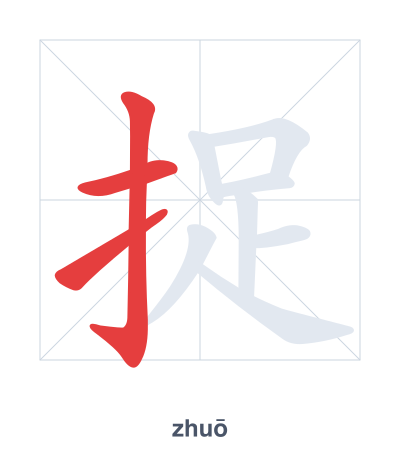
Open Hanzi Writer to see the animated stroke order and practice writing 捉 with real-time feedback.
The character 捉 (zhuō) is written with 10 strokes. Follow the standard Chinese stroke order: top to bottom, left to right, outside before inside. The radical 扌 is one of its key components.
Practice the correct stroke order with the Hanzi Writer app to see animated stroke-by-stroke guidance with real-time feedback.
捉 means to catch.
As an HSK Level 6 character, 捉 is an intermediate-level character.
The character 捉 combines the hand radical 扌 (shǒu) with 足 (zú, foot). While 足 originally contributed to the pronunciation, together they visually suggest using both hands and feet—reaching out to grab and stepping to pursue—to catch something.
💡 Memory Tip: Imagine a hand (扌) swiftly grabbing a running foot (足) to catch it.
孩子们在公园捉迷藏。
hái zi men zài gōng yuán zhuō mí cáng
The children are playing hide-and-seek in the park.
警察捉住了那个小偷。
jǐng chá zhuō zhù le nà ge xiǎo tōu
The police caught that thief.
摄影师捕捉到了美景。
shè yǐng shī bǔ zhuō dào le měi jǐng
The photographer captured the beautiful scenery.
Open Hanzi Writer to see the animated stroke order and practice writing 捉 with real-time feedback.
✨ Animated stroke order · Handwriting recognition · HSK-graded practice · Free to use
捉 is made of two parts: the left radical 扌 (hand) and the right component 足 (foot). The hand radical shows that catching involves the hand, while 足 suggests movement or chasing. Together they represent using your hands to catch something that is moving.