河 (hé) means "river" in Chinese. It has 8 strokes with the radical 氵, and is HSK Level 2.
Rated 3.2/5 in difficulty (challenging).
Harder than 49% of HSK Level 2 characters.
Appears in 3+ common words including 河边 (hé biān), 黄河 (huáng hé), 小河 (xiǎo hé).
Due to its 8 strokes, Hanzi Writer's error detection shows 河 requires focused practice — most learners need 10+ attempts for consistent accuracy.
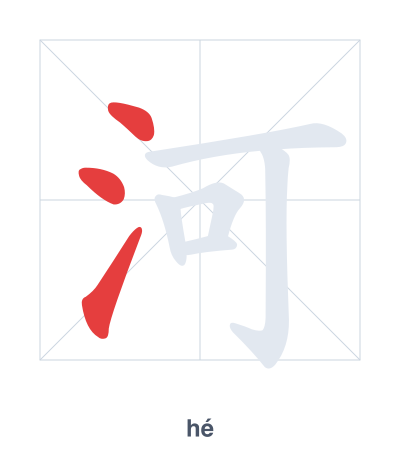
Open Hanzi Writer to see the animated stroke order and practice writing 河 with real-time feedback.
The character 河 (hé) is written with 8 strokes. Follow the standard Chinese stroke order: top to bottom, left to right, outside before inside. The radical 氵 is one of its key components.
Practice the correct stroke order with the Hanzi Writer app to see animated stroke-by-stroke guidance with real-time feedback.
河 means river.
As an HSK Level 2 character, 河 is among the first characters beginners learn.
河 is a phono-semantic compound: the left side 氵 (water) indicates it relates to rivers, while the right side 可 (kě, meaning 'can' or 'able') provides the approximate pronunciation hé. Originally it referred specifically to the Yellow River in ancient China, later broadening to mean any river.
💡 Memory Tip: Imagine a river where you can (可) scoop up water (氵) to drink—so refreshing!
我们在河边钓鱼。
wǒ men zài hé biān diào yú
We are fishing by the river.
黄河是中国第二大河。
huáng hé shì zhōng guó dì èr dà hé
The Yellow River is the second largest river in China.
村口有一条小河。
cūn kǒu yǒu yī tiáo xiǎo hé
There is a small river at the entrance of the village.
Open Hanzi Writer to see the animated stroke order and practice writing 河 with real-time feedback.
✨ Animated stroke order · Handwriting recognition · HSK-graded practice · Free to use
河 is made of two parts: the radical 氵 (water) on the left and 可 (kě) on the right. The water radical directly relates to the meaning 'river', while 可 provides the pronunciation hé but does not contribute to the meaning.