体 (tǐ) means "body; form; system" in Chinese. It has 7 strokes with the radical 亻, and is HSK Level 1.
Rated 2.7/5 in difficulty (moderate).
Harder than 37% of HSK Level 1 characters.
Appears in 3+ common words including 身体 (shēn tǐ), 体育 (tǐ yù), 字体 (zì tǐ).
Hanzi Writer's stroke validation shows learners typically need 5-8 attempts to write 体 with correct proportion and order.
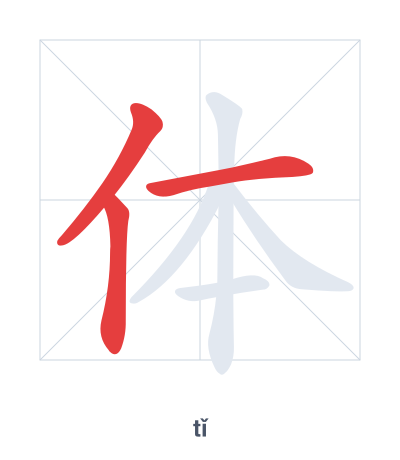
Open Hanzi Writer to see the animated stroke order and practice writing 体 with real-time feedback.
The character 体 (tǐ) is written with 7 strokes. Follow the standard Chinese stroke order: top to bottom, left to right, outside before inside. The radical 亻 is one of its key components.
Practice the correct stroke order with the Hanzi Writer app to see animated stroke-by-stroke guidance with real-time feedback.
体 means body; form; system.
As an HSK Level 1 character, 体 is among the first characters beginners learn.
体 is a simplified compound character combining 亻 (person) and 本 (root), suggesting that the body is the fundamental 'root' of a person. In traditional writing, 體 depicted bones (骨) and ritual vessels (豊), but the simplified form emphasizes the human foundation.
💡 Memory Tip: Picture a person (亻) standing firmly like a tree trunk (本) — that solid form is their body.
你的身体好吗?
nǐ de shēn tǐ hǎo ma
How is your health?
我喜欢体育课。
wǒ xǐ huān tǐ yù kè
I like PE class.
这个字体很漂亮。
zhè ge zì tǐ hěn piào liàng
This font is very beautiful.
Open Hanzi Writer to see the animated stroke order and practice writing 体 with real-time feedback.
✨ Animated stroke order · Handwriting recognition · HSK-graded practice · Free to use
体 is made of the radical 亻, meaning 'person', on the left, and 本, meaning 'root' or 'foundation', on the right. Together, they suggest a person's foundation, which is the body. This structural logic explains why 体 means 'body', 'form', or 'system'.