嗄 (á) means "Hoarse" in Chinese. It has 13 strokes with the radical 口.
Rated 4.2/5 in difficulty (advanced).
Appears in 3+ common words including 嗄声 (á shēng), 嗄哑 (á yǎ), 嗄嗄 (á á).
Due to its 13 strokes, Hanzi Writer's error detection shows 嗄 requires focused practice — most learners need 10+ attempts for consistent accuracy.
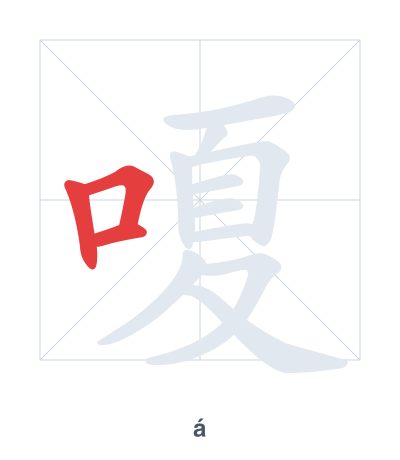
Open Hanzi Writer to see the animated stroke order and practice writing 嗄 with real-time feedback.
The character 嗄 (á) is written with 13 strokes. Follow the standard Chinese stroke order: top to bottom, left to right, outside before inside. The radical 口 is one of its key components.
Practice the correct stroke order with the Hanzi Writer app to see animated stroke-by-stroke guidance with real-time feedback.
嗄 means Hoarse.
嗄 combines the mouth radical 口 (indicating vocal action) with 夏 (summer), suggesting that hot, dry weather can strain the throat, causing hoarseness. The phonetic element 夏 also hints at the sound shift to the reading á.
💡 Memory Tip: Picture a mouth (口) panting under the scorching summer sun (夏), too dry to speak clearly—just a hoarse croak.
他的嗓音带点嗄声。
tā de sǎng yīn dài diǎn á shēng
His voice is a bit raspy.
感冒让他的嗓子嗄哑了。
gǎn mào ràng tā de sǎng zi á yǎ le
The cold made his voice hoarse.
他发出嗄嗄的笑声。
tā fā chū á á de xiào shēng
He let out a hoarse laugh.
Open Hanzi Writer to see the animated stroke order and practice writing 嗄 with real-time feedback.
✨ Animated stroke order · Handwriting recognition · HSK-graded practice · Free to use
嗄 is made of the mouth radical 口 on the left and 夏 (summer) on the right. The mouth radical connects to voice or sound, while 夏 gives the pronunciation á. Together they suggest a hoarse voice, as if from shouting too much in summer.