株 (zhū) means "Plant; Stump; Measure word for plants" in Chinese. It has 10 strokes with the radical 木, and is HSK Level 7.
Rated 4.2/5 in difficulty (advanced).
Harder than 63% of HSK Level 7 characters.
Appears in 3+ common words including 一株 (yī zhū), 守株待兔 (shǒu zhū dài tù), 株距 (zhū jù).
Due to its 10 strokes, Hanzi Writer's error detection shows 株 requires focused practice — most learners need 10+ attempts for consistent accuracy.
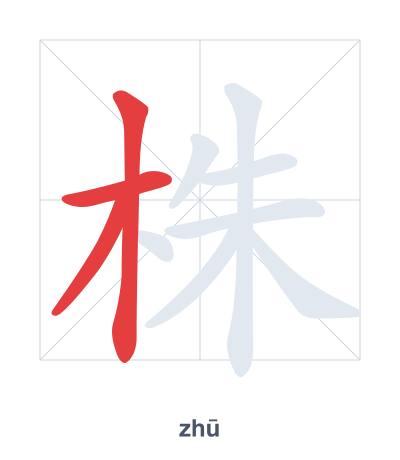
Open Hanzi Writer to see the animated stroke order and practice writing 株 with real-time feedback.
The character 株 (zhū) is written with 10 strokes. Follow the standard Chinese stroke order: top to bottom, left to right, outside before inside. The radical 木 is one of its key components.
Practice the correct stroke order with the Hanzi Writer app to see animated stroke-by-stroke guidance with real-time feedback.
株 means Plant; Stump; Measure word for plants.
As an HSK Level 7 character, 株 is an intermediate-level character.
株 is a compound character with the radical 木 (tree) and phonetic component 朱 (zhū, meaning 'red'). In ancient usage, 朱 originally depicted a tree trunk or stump, so combining it with 木 emphasized the meaning of a plant stem or stump, later extended to a measure word for plants.
💡 Memory Tip: Imagine a red (朱) tree stump (木) that has a single plant growing from it, reminding you that 株 means both 'stump' and 'plant' as a measure word.
庭院里栽种着一株兰花,散发着阵阵幽香。
tíng yuàn lǐ zāi zhòng zhe yī zhū lán huā , sàn fà zhe zhèn zhèn yōu xiāng 。
An orchid is planted in the courtyard, emitting a faint fragrance.
我们不能守株待兔。
wǒ men bù néng shǒu zhū dài tù
We cannot just sit back and wait for luck.
请注意植物的株距。
qǐng zhù yì zhí wù de zhū jù
Please pay attention to the spacing between plants.
Open Hanzi Writer to see the animated stroke order and practice writing 株 with real-time feedback.
✨ Animated stroke order · Handwriting recognition · HSK-graded practice · Free to use
株 combines the radical 木 (wood/tree) on the left with 朱 (zhū, meaning red or a proper name) on the right. Since 木 relates to trees, and 朱 provides the sound, the character originally referred to a tree stump or a plant. Together, they form the idea of a plant or a stump, and later became a measure word for plants.