兔 (tù) means "rabbit" in Chinese. It has 8 strokes with the radical 儿, and is HSK Level 5.
Rated 3.4/5 in difficulty (challenging).
Harder than 19% of HSK Level 5 characters.
Appears in 3+ common words including 兔子 (tù zi), 兔年 (tù nián), 小兔 (xiǎo tù).
Due to its 8 strokes, Hanzi Writer's error detection shows 兔 requires focused practice — most learners need 10+ attempts for consistent accuracy.
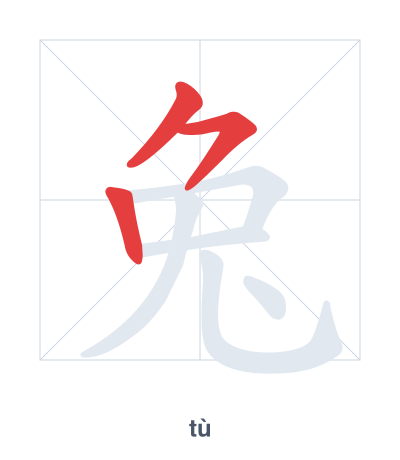
Open Hanzi Writer to see the animated stroke order and practice writing 兔 with real-time feedback.
The character 兔 (tù) is written with 8 strokes. Follow the standard Chinese stroke order: top to bottom, left to right, outside before inside. The radical 儿 is one of its key components.
Practice the correct stroke order with the Hanzi Writer app to see animated stroke-by-stroke guidance with real-time feedback.
兔 means rabbit.
As an HSK Level 5 character, 兔 is an intermediate-level character.
This character is a pictograph of a rabbit. The ancient form depicted the animal with long ears and a short tail, and the modern shape retains a dot (丶) above the component 免 to represent the rabbit's distinctive tail.
💡 Memory Tip: Picture a rabbit (免) with a tiny dot (丶) on its rear—that's its cute little tail.
兔子喜欢吃胡萝卜。
tù zi xǐ huān chī hú luó bo
Rabbits like to eat carrots.
明年是兔年。
míng nián shì tù nián
Next year is the Year of the Rabbit.
那只小兔很可爱。
nà zhǐ xiǎo tù hěn kě ài
That little rabbit is very cute.
Open Hanzi Writer to see the animated stroke order and practice writing 兔 with real-time feedback.
✨ Animated stroke order · Handwriting recognition · HSK-graded practice · Free to use
The top part of 兔 looks like a rabbit's head with a dot representing its eye, and the bottom radical 儿 suggests its two legs. Together, they form a simple picture of a rabbit sitting upright, which directly relates to the meaning of 'rabbit'.