武 (wǔ) means "Martial / Military" in Chinese. It has 8 strokes with the radical 止, and is HSK Level 3.
Rated 3.7/5 in difficulty (challenging).
Harder than 51% of HSK Level 3 characters.
Appears in 3+ common words including 武术 (wǔ shù), 武器 (wǔ qì), 文武 (wén wǔ).
Due to its 8 strokes, Hanzi Writer's error detection shows 武 requires focused practice — most learners need 10+ attempts for consistent accuracy.
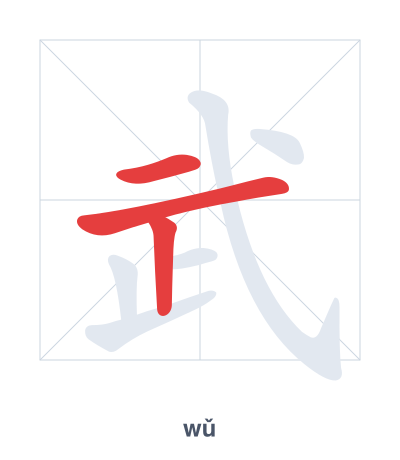
Open Hanzi Writer to see the animated stroke order and practice writing 武 with real-time feedback.
The character 武 (wǔ) is written with 8 strokes. Follow the standard Chinese stroke order: top to bottom, left to right, outside before inside. The radical 止 is one of its key components.
Practice the correct stroke order with the Hanzi Writer app to see animated stroke-by-stroke guidance with real-time feedback.
武 means Martial / Military.
As an HSK Level 3 character, 武 is an intermediate-level character.
武 combines 止 (to stop) and 戈 (spear/dagger-axe), originally depicting a person marching with a weapon—suggesting the dual sense of 'martial' as both armed force and the ability to stop violence. The character's ancient form showed a foot (止) advancing toward or away from a halberd (戈), later simplified into the modern shape.
💡 Memory Tip: Picture a martial arts master using a spear (戈) to block an enemy's foot (止)—stopping the attack with weaponry.
他从小学习武术。
tā cóng xiǎo xué xí wǔ shù
He has been studying martial arts since he was a child.
这是古代的武器。
zhè shì gǔ dài de wǔ qì
This is an ancient weapon.
他是一个文武双全的人。
tā shì yí gè wén wǔ shuāng quán de rén
He is a person adept in both scholarly and martial arts.
Open Hanzi Writer to see the animated stroke order and practice writing 武 with real-time feedback.
✨ Animated stroke order · Handwriting recognition · HSK-graded practice · Free to use
武 is made of 止 (meaning 'stop') on top and 戈 (meaning 'halberd' or 'weapon') below. Together, they suggest the idea of stopping conflict with military force, which explains its meaning 'martial' or 'military'.