歨 (bù) means "Step (archaic variant of 步)" in Chinese. It has 8 strokes with the radical 止.
Rated 3.7/5 in difficulty (challenging).
Appears in 3+ common words including 歨行 (bù xíng), 歨步 (bù bù), 歨子 (bù zi).
Due to its 8 strokes, Hanzi Writer's error detection shows 歨 requires focused practice — most learners need 10+ attempts for consistent accuracy.
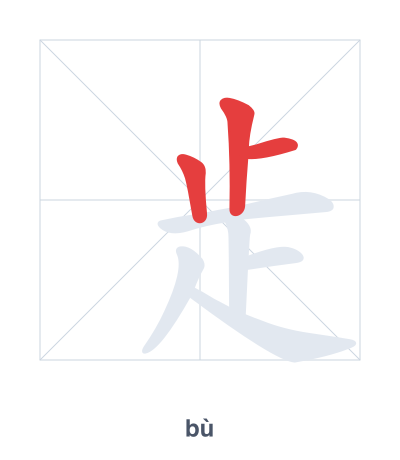
Open Hanzi Writer to see the animated stroke order and practice writing 歨 with real-time feedback.
The character 歨 (bù) is written with 8 strokes. Follow the standard Chinese stroke order: top to bottom, left to right, outside before inside. The radical 止 is one of its key components.
Practice the correct stroke order with the Hanzi Writer app to see animated stroke-by-stroke guidance with real-time feedback.
歨 means Step (archaic variant of 步).
| Character | 歨 |
| Pinyin | bù (bu) |
| Meaning | Step (archaic variant of 步) |
| Strokes | 8 |
| Radical | 止 |
| Difficulty | 3.7/5 |
This character is an archaic variant of 步, depicting two feet in motion. The top part 止 represents a left foot, and the bottom part 夊 (a variant of 止) represents a right foot, together symbolizing the act of taking a step.
💡 Memory Tip: Picture a left foot (止) stepping forward, followed by a right foot (夊) — two feet marching in sequence to make a step.
我们歨行去学校。
wǒ men bù xíng qù xué xiào
We walk to school.
他歨步稳健。
tā bù bù wěn jiàn
His steps are steady.
他的歨子很快。
tā de bù zi hěn kuài
His pace is very fast.
Open Hanzi Writer to see the animated stroke order and practice writing 歨 with real-time feedback.
✨ Animated stroke order · Handwriting recognition · HSK-graded practice · Free to use
The character 歨 is composed of 止 (stop/toe) at the top, which represents a footprint or foot, and 少 (few/little) at the bottom. Together, they depict a foot making a small movement, symbolizing a single step. This structure matches the original meaning of 步 (step), but 歨 is a rarer variant.