歪 (wāi) means "Crooked; slanted; devious" in Chinese. It has 9 strokes with the radical 止, and is HSK Level 7.
Rated 3.7/5 in difficulty (challenging).
Harder than 28% of HSK Level 7 characters.
Appears in 3+ common words including 歪了 (wāi le), 歪头 (wāi tóu), 歪理 (wāi lǐ).
Due to its 9 strokes, Hanzi Writer's error detection shows 歪 requires focused practice — most learners need 10+ attempts for consistent accuracy.
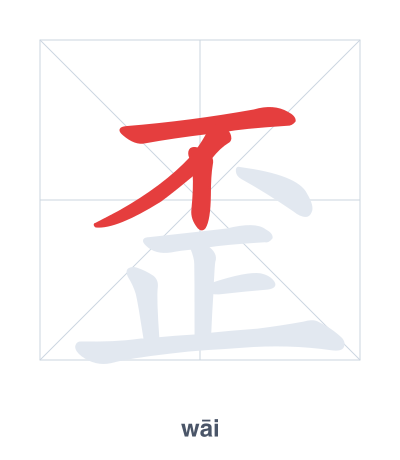
Open Hanzi Writer to see the animated stroke order and practice writing 歪 with real-time feedback.
The character 歪 (wāi) is written with 9 strokes. Follow the standard Chinese stroke order: top to bottom, left to right, outside before inside. The radical 止 is one of its key components.
Practice the correct stroke order with the Hanzi Writer app to see animated stroke-by-stroke guidance with real-time feedback.
歪 means Crooked; slanted; devious.
As an HSK Level 7 character, 歪 is an intermediate-level character.
歪 is a compound of 不 (not) and 正 (upright/straight). Together they signify 'not upright,' directly conveying the meaning of crooked or slanted.
💡 Memory Tip: Imagine a wobbly sign that says 'not correct' (不正) hanging crookedly on a wall.
你的帽子戴歪了。
nǐ de mào zi dài wāi le
Your hat is on crooked.
那个孩子歪头站着,好奇地打量着这位陌生人。
nà ge hái zi wāi tóu zhàn zhe , hào qí dì dǎ liàng zhe zhè wèi mò shēng rén 。
The child stood with his head tilted, curiously looking at the stranger.
他总是有很多歪理。
tā zǒng shì yǒu hěn duō wāi lǐ
He always has a lot of twisted logic.
Open Hanzi Writer to see the animated stroke order and practice writing 歪 with real-time feedback.
✨ Animated stroke order · Handwriting recognition · HSK-graded practice · Free to use
歪 is made of two parts: 不 (meaning 'not') on the left and 正 (meaning 'upright' or 'straight') on the right. Together they mean 'not straight,' which gives the core meaning of crooked, slanted, or devious.