歰 (sè) means "Astringent (archaic variant of 涩)" in Chinese. It has 14 strokes with the radical 止.
Rated 3.8/5 in difficulty (challenging).
Appears in 3+ common words including 歰味 (sè wèi), 艰歰 (jiān sè), 枯歰 (kū sè).
Due to its 14 strokes, Hanzi Writer's error detection shows 歰 requires focused practice — most learners need 10+ attempts for consistent accuracy.
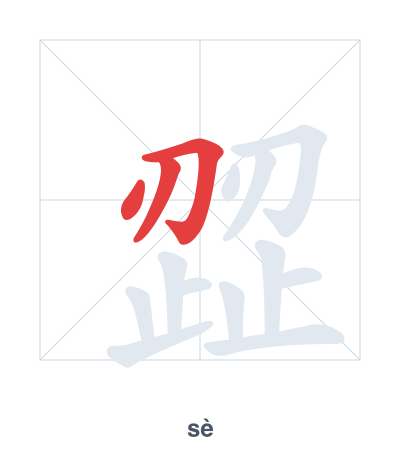
Open Hanzi Writer to see the animated stroke order and practice writing 歰 with real-time feedback.
The character 歰 (sè) is written with 14 strokes. Follow the standard Chinese stroke order: top to bottom, left to right, outside before inside. The radical 止 is one of its key components.
Practice the correct stroke order with the Hanzi Writer app to see animated stroke-by-stroke guidance with real-time feedback.
歰 means Astringent (archaic variant of 涩).
| Character | 歰 |
| Pinyin | sè (se) |
| Meaning | Astringent (archaic variant of 涩) |
| Strokes | 14 |
| Radical | 止 |
| Difficulty | 3.8/5 |
歰 is an archaic variant of 涩, meaning 'astringent' or 'rough'. It combines two 止 (feet) with a horizontal stroke (一) representing an obstruction, visually depicting feet stuck or unable to move smoothly, evoking a puckery, hindered sensation.
💡 Memory Tip: Imagine two feet (止) stuck on either side of a rough horizontal line (一), making you pucker as if licking an unripe persimmon.
这个柿子有歰味。
zhè ge shì zi yǒu sè wèi
This persimmon has an astringent taste.
这篇文章很艰歰。
zhè piān wén zhāng hěn jiān sè
This article is very difficult to read.
他的眼神很枯歰。
tā de yǎn shén hěn kū sè
His eyes look dry and dull.
Open Hanzi Writer to see the animated stroke order and practice writing 歰 with real-time feedback.
✨ Animated stroke order · Handwriting recognition · HSK-graded practice · Free to use
歰 is composed of 止 (stop) on top and two 刃 (blade) components below. The image of stopping blades may suggest a puckering, cutting sensation in the mouth, which matches the astringent taste this character describes.