抬 (tái) means "to lift or carry" in Chinese. It has 8 strokes with the radical 扌, and is HSK Level 5.
Rated 3.7/5 in difficulty (challenging).
Harder than 34% of HSK Level 5 characters.
Appears in 3+ common words including 抬头 (tái tóu), 抬走 (tái zǒu), 抬手 (tái shǒu).
Due to its 8 strokes, Hanzi Writer's error detection shows 抬 requires focused practice — most learners need 10+ attempts for consistent accuracy.
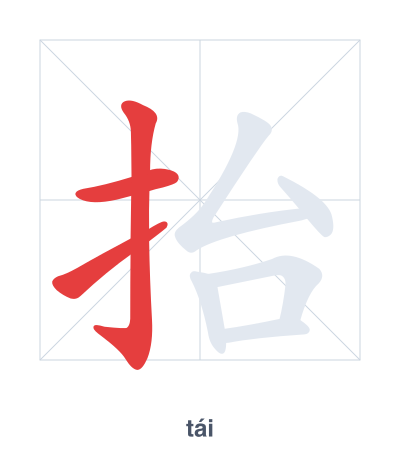
Open Hanzi Writer to see the animated stroke order and practice writing 抬 with real-time feedback.
The character 抬 (tái) is written with 8 strokes. Follow the standard Chinese stroke order: top to bottom, left to right, outside before inside. The radical 扌 is one of its key components.
Practice the correct stroke order with the Hanzi Writer app to see animated stroke-by-stroke guidance with real-time feedback.
抬 means to lift or carry.
As an HSK Level 5 character, 抬 is an intermediate-level character.
抬 combines the hand radical 扌 with 台, which originally depicted a raised platform or terrace. The compound suggests using one's hands to lift something up onto or away from a raised surface, giving the meaning 'to lift' or 'to carry' between two or more people.
💡 Memory Tip: Imagine two hands (扌) lifting a heavy box onto a raised platform (台), working together to carry it high.
请大家抬头看黑板。
qǐng dà jiā tái tóu kàn hēi bǎn
Everyone, please look up at the blackboard.
把这张桌子抬走。
bǎ zhè zhāng zhuō zi tái zǒu
Carry this table away.
他抬手看了看表。
tā tái shǒu kàn le kàn biǎo
He raised his hand and looked at his watch.
Open Hanzi Writer to see the animated stroke order and practice writing 抬 with real-time feedback.
✨ Animated stroke order · Handwriting recognition · HSK-graded practice · Free to use
抬 is made of the hand radical 扌 on the left and 台 (platform) on the right. The hand radical shows the action is done by hand, while 台 suggests the idea of raising or lifting something upward. Together they create the meaning "to lift or carry."