鹧 (zhè) means "partridge" in Chinese. It has 16 strokes with the radical 鸟.
Rated 4.2/5 in difficulty (advanced).
Appears in 3+ common words including 鹧鸪 (zhè gū), 鹧鸪菜 (zhè gū cài), 鹧鸪天 (zhè gū tiān).
Due to its 16 strokes, Hanzi Writer's error detection shows 鹧 requires focused practice — most learners need 10+ attempts for consistent accuracy.
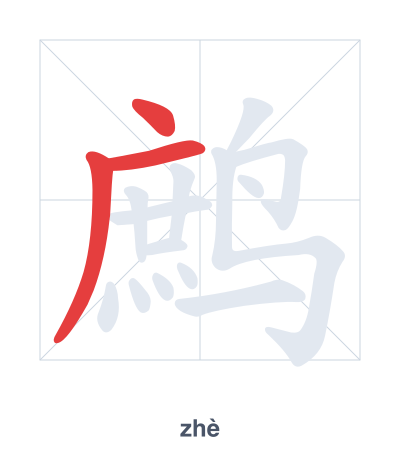
Open Hanzi Writer to see the animated stroke order and practice writing 鹧 with real-time feedback.
The character 鹧 (zhè) is written with 16 strokes. Follow the standard Chinese stroke order: top to bottom, left to right, outside before inside. The radical 鸟 is one of its key components.
Practice the correct stroke order with the Hanzi Writer app to see animated stroke-by-stroke guidance with real-time feedback.
鹧 means partridge.
鹧 is a phono-semantic compound: the left component 者 (zhě) provides the approximate pronunciation, while the right component 鸟 (bird) indicates the meaning. Together they identify a specific game bird, the partridge, noted for its distinctive call.
💡 Memory Tip: Imagine a partridge wearing a scholar's hat (者) while perching on a branch, looking like a wise 'one who' knows the forest.
山里有鹧鸪在叫。
shān lǐ yǒu zhè gū zài jiào
Partridges are calling in the mountains.
这是一种中药鹧鸪菜。
zhè shì yī zhǒng zhōng yào zhè gū cài
This is a type of Chinese herbal medicine called Zhegu cai (Caloglossa).
这是一个词牌名。
zhè shì yí gè cí pái míng
This is the name of a Ci-poem melody.
Open Hanzi Writer to see the animated stroke order and practice writing 鹧 with real-time feedback.
✨ Animated stroke order · Handwriting recognition · HSK-graded practice · Free to use
鹧 is a left-right character. The left part 者 (zhě) gives the sound, and the right part 鸟 (bird) indicates that it is a type of bird. Together they form the word for partridge.