鸪 (gū) means "Partridge" in Chinese. It has 10 strokes with the radical 鸟.
Rated 4.2/5 in difficulty (advanced).
Appears in 3+ common words including 鹧鸪 (zhè gū), 鹧鸪菜 (zhè gū cài), 鸪鸪 (gū gū).
Due to its 10 strokes, Hanzi Writer's error detection shows 鸪 requires focused practice — most learners need 10+ attempts for consistent accuracy.
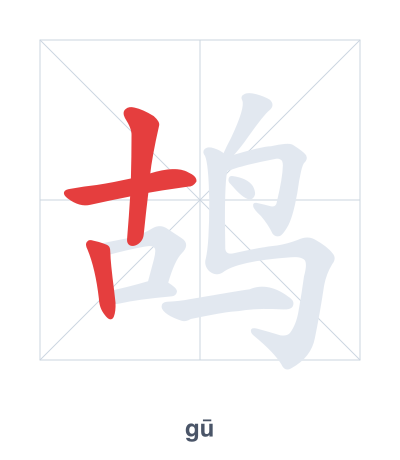
Open Hanzi Writer to see the animated stroke order and practice writing 鸪 with real-time feedback.
The character 鸪 (gū) is written with 10 strokes. Follow the standard Chinese stroke order: top to bottom, left to right, outside before inside. The radical 鸟 is one of its key components.
Practice the correct stroke order with the Hanzi Writer app to see animated stroke-by-stroke guidance with real-time feedback.
鸪 means Partridge.
鸪 is a phono-semantic compound where 鸟 (bird) indicates the meaning 'partridge' and 古 (gǔ) provides the pronunciation cue. The character visually combines a general bird radical with an ancient sound component, reflecting how the partridge was named after its distinctive call.
💡 Memory Tip: Picture an ancient (古) bird (鸟) that walks along the ground calling 'gu-gu' — that's the partridge.
树林里有鹧鸪。
shù lín lǐ yǒu zhè gū
There are partridges in the woods.
这是一种中药。
zhè shì yī zhǒng zhōng yào
This is a type of Chinese medicine.
鸟儿发出鸪鸪的叫声。
niǎo ér fā chū gū gū de jiào shēng
The bird made a cooing sound.
Open Hanzi Writer to see the animated stroke order and practice writing 鸪 with real-time feedback.
✨ Animated stroke order · Handwriting recognition · HSK-graded practice · Free to use
鸪 is a left-right character: the left part is 古 (ancient, phonetic) and the right part is 鸟 (bird, semantic). The bird radical tells you this character refers to a type of bird, while 古 gives a clue to the pronunciation "gū". This is a typical structure for many bird names in Chinese.