鹕 (hú) means "pelican" in Chinese. It has 14 strokes with the radical 鸟.
Rated 4.2/5 in difficulty (advanced).
Appears in 3+ common words including 鹈鹕 (tí hú), 鹈鹕鸟 (tí hú niǎo), 小鹈鹕 (xiǎo tí hú).
Due to its 14 strokes, Hanzi Writer's error detection shows 鹕 requires focused practice — most learners need 10+ attempts for consistent accuracy.
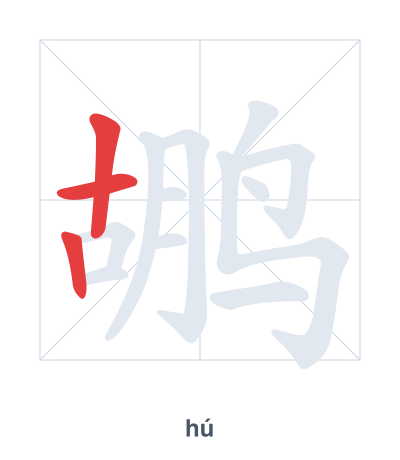
Open Hanzi Writer to see the animated stroke order and practice writing 鹕 with real-time feedback.
The character 鹕 (hú) is written with 14 strokes. Follow the standard Chinese stroke order: top to bottom, left to right, outside before inside. The radical 鸟 is one of its key components.
Practice the correct stroke order with the Hanzi Writer app to see animated stroke-by-stroke guidance with real-time feedback.
鹕 means pelican.
This character is a phono-semantic compound: the left component 胡 (hú) provides the sound, while the right component 鸟 (bird) indicates that it is a type of bird. Together they form the word for 'pelican', a large water bird known for its distinctive pouch-like beak.
💡 Memory Tip: Imagine the left part 胡 as a pelican's big beak (古) and round body (月) attached to the bird radical 鸟 on the right, forming a bird with a huge pouch.
鹈鹕在水里游。
tí hú zài shuǐ lǐ yóu
The pelican is swimming in the water.
鹈鹕鸟的嘴很大。
tí hú niǎo de zuǐ hěn dà
The pelican bird has a very large beak.
小鹈鹕很可爱。
xiǎo tí hú hěn kě ài
The little pelican is very cute.
Open Hanzi Writer to see the animated stroke order and practice writing 鹕 with real-time feedback.
✨ Animated stroke order · Handwriting recognition · HSK-graded practice · Free to use
The character 鹕 is a left-right structure. The left part 胡 (hú) provides the sound, while the right part 鸟 (niǎo) means "bird," showing that 鹕 refers to a type of bird. Together they form the word for pelican.