鹘 (gǔ) means "falcon; goshawk" in Chinese. It has 14 strokes with the radical 鸟.
Rated 4.2/5 in difficulty (advanced).
Appears in 3+ common words including 鹘鸟 (gǔ niǎo), 隼鹘 (sǔn gǔ), 飞鹘 (fēi gǔ).
Due to its 14 strokes, Hanzi Writer's error detection shows 鹘 requires focused practice — most learners need 10+ attempts for consistent accuracy.
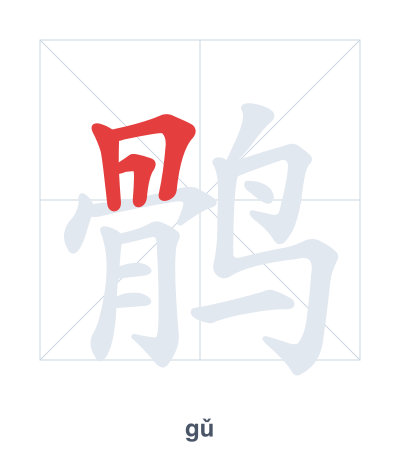
Open Hanzi Writer to see the animated stroke order and practice writing 鹘 with real-time feedback.
The character 鹘 (gǔ) is written with 14 strokes. Follow the standard Chinese stroke order: top to bottom, left to right, outside before inside. The radical 鸟 is one of its key components.
Practice the correct stroke order with the Hanzi Writer app to see animated stroke-by-stroke guidance with real-time feedback.
鹘 means falcon; goshawk.
鹘 is a phono-semantic compound: the left component 骨 (gǔ, 'bone') hints at the pronunciation, while the right component 鸟 (niǎo, 'bird') indicates that it is a type of bird. The character thus literally means 'bone-bird', possibly referencing the falcon's sharp, bone-like beak or its swift, bony frame.
💡 Memory Tip: Imagine a falcon soaring with a bone in its beak — the left 'bone' (骨) and right 'bird' (鸟) combine to show this predatory bird carrying its bony prize.
鹘鸟飞得很快。
gǔ niǎo fēi dé hěn kuài
Falcons fly very fast.
隼鹘是一种猎鸟。
sǔn gǔ shì yī zhǒng liè niǎo
The falcon is a type of bird of prey.
飞鹘在天空中盘旋。
fēi gǔ zài tiān kōng zhōng pán xuán
The falcon is circling in the sky.
Open Hanzi Writer to see the animated stroke order and practice writing 鹘 with real-time feedback.
✨ Animated stroke order · Handwriting recognition · HSK-graded practice · Free to use
The left side is the radical 鸟 (niǎo, bird), showing this character belongs to the bird category. The right side is 骨 (gǔ, bone), which hints at the strong, bony build of falcons and hawks. Together, 鹘 forms the image of a bird of prey with a robust skeleton.