鹗 (è) means "osprey; fish hawk" in Chinese. It has 14 strokes with the radical 鸟.
Rated 4.2/5 in difficulty (advanced).
Appears in 3+ common words including 鱼鹗 (yú è), 鹗鸟 (è niǎo), 雄鹗 (xióng è).
Due to its 14 strokes, Hanzi Writer's error detection shows 鹗 requires focused practice — most learners need 10+ attempts for consistent accuracy.
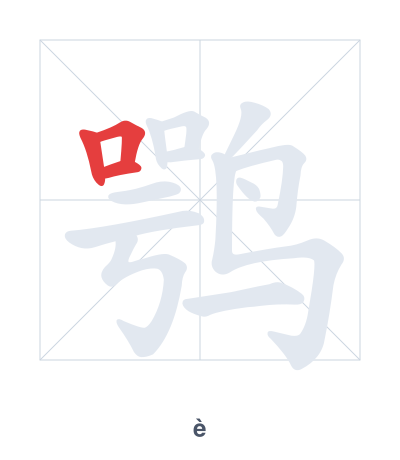
Open Hanzi Writer to see the animated stroke order and practice writing 鹗 with real-time feedback.
The character 鹗 (è) is written with 14 strokes. Follow the standard Chinese stroke order: top to bottom, left to right, outside before inside. The radical 鸟 is one of its key components.
Practice the correct stroke order with the Hanzi Writer app to see animated stroke-by-stroke guidance with real-time feedback.
鹗 means osprey; fish hawk.
鹗 combines 鸟 (bird) on the right with 咢 (è, meaning 'jaw' or 'startled') on the left. The left component acts as a phonetic element while also hinting at the osprey’s powerful jaw, used to catch fish. Together, the character depicts a bird with a strong beak—the fish hawk.
💡 Memory Tip: Imagine an osprey with a massive jaw (咢) that says 'Awk!' as it snatches a fish from the lake.
鱼鹗在水面上飞。
yú è zài shuǐ miàn shàng fēi
The osprey is flying over the water.
鹗鸟在抓鱼。
è niǎo zài zhuā yú
The osprey is catching fish.
雄鹗在寻找食物。
xióng è zài xún zhǎo shí wù
The male osprey is looking for food.
Open Hanzi Writer to see the animated stroke order and practice writing 鹗 with real-time feedback.
✨ Animated stroke order · Handwriting recognition · HSK-graded practice · Free to use
鹗 is made of two parts: the left side 鱼 (fish) and the right side 鸟 (bird). Since an osprey is a bird that hunts fish, the character combines fish and bird to show its role as a fish hawk.