债 (zhài) means "debt" in Chinese. It has 10 strokes with the radical 亻, and is HSK Level 6.
Rated 3.9/5 in difficulty (challenging).
Harder than 37% of HSK Level 6 characters.
Appears in 3+ common words including 欠债 (qiàn zhài), 还债 (huán zhài), 借债 (jiè zhài).
Due to its 10 strokes, Hanzi Writer's error detection shows 债 requires focused practice — most learners need 10+ attempts for consistent accuracy.
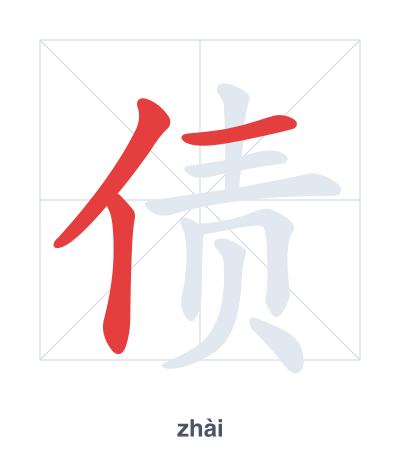
Open Hanzi Writer to see the animated stroke order and practice writing 债 with real-time feedback.
The character 债 (zhài) is written with 10 strokes. Follow the standard Chinese stroke order: top to bottom, left to right, outside before inside. The radical 亻 is one of its key components.
Practice the correct stroke order with the Hanzi Writer app to see animated stroke-by-stroke guidance with real-time feedback.
债 means debt.
As an HSK Level 6 character, 债 is an intermediate-level character.
债 combines 亻 (person) with 责 (responsibility), indicating a debt is a person's financial responsibility. The left side shows the person, while 责 originally meant 'to demand' or 'duty', implying the owed amount is something demanded back.
💡 Memory Tip: Imagine a person (亻) weighed down by a heavy backpack labeled '责' (responsibility), carrying the burden of debt everywhere.
他欠债很多。
tā qiàn zhài hěn duō
He owes a lot of debt.
我要努力还债。
wǒ yào nǔ lì huán zhài
I must work hard to pay off my debts.
借债不是好习惯。
jiè zhài bú shì hǎo xí guàn
Borrowing money is not a good habit.
Open Hanzi Writer to see the animated stroke order and practice writing 债 with real-time feedback.
✨ Animated stroke order · Handwriting recognition · HSK-graded practice · Free to use
The character 债 combines the radical 亻 (person) on the left with 责 (zé, responsibility) on the right. Together, they suggest a person's responsibility to repay money, which is the core idea of debt.