躁 (zào) means "impatient; restless" in Chinese. It has 20 strokes with the radical 足, and is HSK Level 7.
Rated 4.2/5 in difficulty (advanced).
Harder than 92% of HSK Level 7 characters.
Appears in 3+ common words including 急躁 (jí zào), 烦躁 (fán zào), 躁动 (zào dòng).
Due to its 20 strokes, Hanzi Writer's error detection shows 躁 requires focused practice — most learners need 10+ attempts for consistent accuracy.
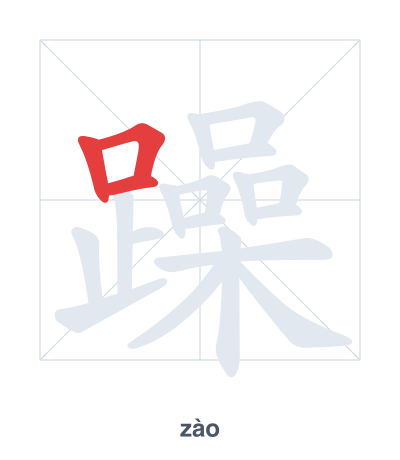
Open Hanzi Writer to see the animated stroke order and practice writing 躁 with real-time feedback.
The character 躁 (zào) is written with 20 strokes. Follow the standard Chinese stroke order: top to bottom, left to right, outside before inside. The radical 足 is one of its key components.
Practice the correct stroke order with the Hanzi Writer app to see animated stroke-by-stroke guidance with real-time feedback.
躁 means impatient; restless.
As an HSK Level 7 character, 躁 is an intermediate-level character.
躁 combines the radical 足 (foot) with the phonetic component 喿 (zào, meaning 'chirping' or 'noisy'). It evokes the image of restless feet making a constant, irritating noise—like pacing or tapping—reflecting impatience and agitation.
💡 Memory Tip: Picture impatient feet (足) stomping noisily (喿) on the ground because they can't stand waiting another second.
他的性格比较急躁。
tā de xìng gé bǐ jiào jí zào
He has a rather impatient personality.
天气太热,让人感到烦躁。
tiān qì tài rè ràng rén gǎn dào fán zào
The weather is so hot that it makes people feel irritable.
春天到了,万物开始躁动。
chūn tiān dào le wàn wù kāi shǐ zào dòng
Spring has arrived, and everything is starting to stir.
Open Hanzi Writer to see the animated stroke order and practice writing 躁 with real-time feedback.
✨ Animated stroke order · Handwriting recognition · HSK-graded practice · Free to use
The left side is the radical 足 (foot), which hints at movement or action. The right side is 喿 (zào), which originally suggested noise or agitation. Together, they create the idea of restless or impatient movement, like someone pacing nervously.