蹙 (cù) means "To knit (brows); to frown; urgent" in Chinese. It has 18 strokes with the radical 足.
Rated 4.2/5 in difficulty (advanced).
Appears in 3+ common words including 蹙眉 (cù méi), 蹙着眉 (cù zhe méi), 蹙额 (cù é).
Due to its 18 strokes, Hanzi Writer's error detection shows 蹙 requires focused practice — most learners need 10+ attempts for consistent accuracy.
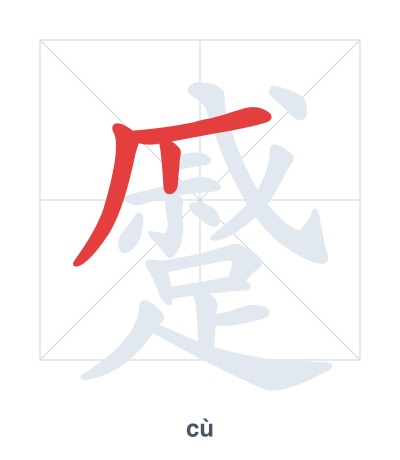
Open Hanzi Writer to see the animated stroke order and practice writing 蹙 with real-time feedback.
The character 蹙 (cù) is written with 18 strokes. Follow the standard Chinese stroke order: top to bottom, left to right, outside before inside. The radical 足 is one of its key components.
Practice the correct stroke order with the Hanzi Writer app to see animated stroke-by-stroke guidance with real-time feedback.
蹙 means To knit (brows); to frown; urgent.
蹙 combines the radical 足 (foot) with 戚 (sorrow), suggesting the anxious, hurried steps of someone under distress. This sense of worry and pressure transferred to the facial expression of knitting one's brows or frowning.
💡 Memory Tip: Imagine a worried person stepping on a thorn (戚 looks like a thorny plant) and frowning as they hobble away on their foot (足).
她听了这话,微微蹙眉。
tā tīng le zhè huà wēi wēi cù méi
She frowned slightly after hearing this.
别总是蹙着眉头。
bié zǒng shì cù zhe méi tóu
Don't always frown.
他蹙额思考着问题。
tā cù é sī kǎo zhe wèn tí
He frowned while thinking about the problem.
Open Hanzi Writer to see the animated stroke order and practice writing 蹙 with real-time feedback.
✨ Animated stroke order · Handwriting recognition · HSK-graded practice · Free to use
蹙 is made of 足 (foot) on top and 戚 (sorrow or relatives) underneath. The foot component suggests pressing or stepping, while 戚 adds a sense of distress, together conveying the idea of furrowing one's brows in worry or urgency.