急 (jí) means "urgent; hurried" in Chinese. It has 9 strokes with the radical 心, and is HSK Level 2.
Rated 3.5/5 in difficulty (challenging).
Harder than 62% of HSK Level 2 characters.
Appears in 3+ common words including 着急 (zháo jí), 紧急 (jǐn jí), 急忙 (jí máng).
Due to its 9 strokes, Hanzi Writer's error detection shows 急 requires focused practice — most learners need 10+ attempts for consistent accuracy.
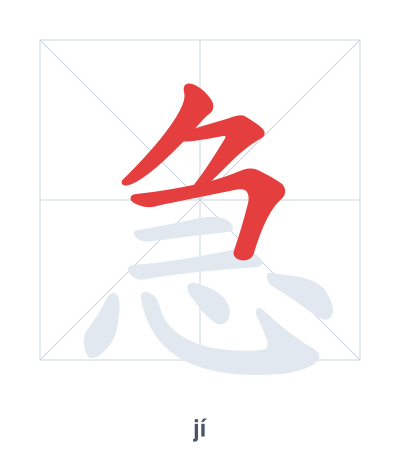
Open Hanzi Writer to see the animated stroke order and practice writing 急 with real-time feedback.
The character 急 (jí) is written with 9 strokes. Follow the standard Chinese stroke order: top to bottom, left to right, outside before inside. The radical 心 is one of its key components.
Practice the correct stroke order with the Hanzi Writer app to see animated stroke-by-stroke guidance with real-time feedback.
急 means urgent; hurried.
As an HSK Level 2 character, 急 is among the first characters beginners learn.
急 combines the phonetic component 刍 (knife above mouth, originally meaning 'cut grass') with the radical 心 (heart). The image of a knife near the mouth and heart evokes a sense of immediate danger or pressure, giving the meaning 'urgent; hurried.'
💡 Memory Tip: A knife (刍's 刀) at your mouth (口) and heart (心)—that's an emergency you can't ignore!
别着急,慢慢说。
bié zháo jí màn màn shuō
Don't worry, take your time and speak.
这是一个紧急情况。
zhè shì yí gè jǐn jí qíng kuàng
This is an emergency.
他急忙跑了出去。
tā jí máng pǎo le chū qù
He rushed out in a hurry.
Open Hanzi Writer to see the animated stroke order and practice writing 急 with real-time feedback.
✨ Animated stroke order · Handwriting recognition · HSK-graded practice · Free to use
急 is made of two parts: the top 刍 (chú) and the bottom 心 (heart). The bottom 心 shows that the meaning relates to emotions or feelings, and the top 刍 gives a hint to the pronunciation. Together, they suggest a heart that is in a hurry, creating the idea of being urgent or hurried.