蹚 (tāng) means "To wade; to ford" in Chinese. It has 18 strokes with the radical 足.
Rated 4.2/5 in difficulty (advanced).
Appears in 3+ common words including 蹚水 (tāng shuǐ), 蹚浑水 (tāng hún shuǐ), 蹚路 (tāng lù).
Due to its 18 strokes, Hanzi Writer's error detection shows 蹚 requires focused practice — most learners need 10+ attempts for consistent accuracy.
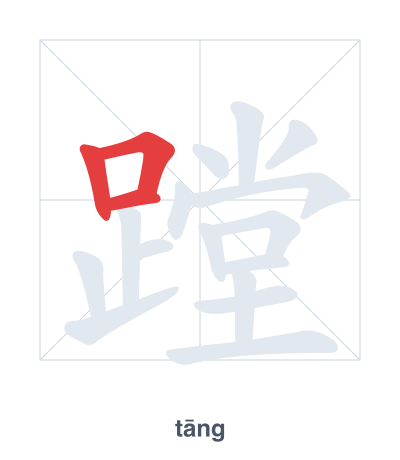
Open Hanzi Writer to see the animated stroke order and practice writing 蹚 with real-time feedback.
The character 蹚 (tāng) is written with 18 strokes. Follow the standard Chinese stroke order: top to bottom, left to right, outside before inside. The radical 足 is one of its key components.
Practice the correct stroke order with the Hanzi Writer app to see animated stroke-by-stroke guidance with real-time feedback.
蹚 means To wade; to ford.
蹚 is a compound character built from the radical 足 (foot, showing the action is foot-related) and the phonetic component 堂 (táng, originally meaning 'hall' but here providing the sound). The character conveys the idea of stepping through water or thick growth, as if one's foot is pushing through obstacles in a hall-like space.
💡 Memory Tip: Imagine a foot (足) wading through a flooded hall (堂), pushing water aside with each step.
我们蹚着水过河。
wǒ men tāng zhe shuǐ guò hé
We waded across the river.
别去蹚那道浑水。
bié qù tāng nà dào hún shuǐ
Don't get involved in that mess.
他在前面为我们蹚路。
tā zài qián miàn wèi wǒ men tāng lù
He is clearing the path for us ahead.
Open Hanzi Writer to see the animated stroke order and practice writing 蹚 with real-time feedback.
✨ Animated stroke order · Handwriting recognition · HSK-graded practice · Free to use
蹚 is made of the radical 足 (foot) on the left and the phonetic component 堂 (táng, hall) on the right. The foot radical indicates that the character involves a foot action, while 堂 provides the sound tāng. Together they describe the action of walking through water or obstacles with your feet.