蹡 (qiāng) means "To walk rapidly; to move rhythmically" in Chinese. It has 18 strokes with the radical 足.
Rated 4.2/5 in difficulty (advanced).
Appears in 3+ common words including 蹡蹡 (qiāng qiāng), 蹡踉 (qiāng liáng), 蹡步 (qiāng bù).
Due to its 18 strokes, Hanzi Writer's error detection shows 蹡 requires focused practice — most learners need 10+ attempts for consistent accuracy.
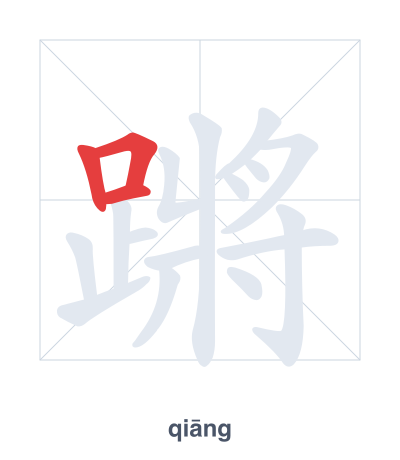
Open Hanzi Writer to see the animated stroke order and practice writing 蹡 with real-time feedback.
The character 蹡 (qiāng) is written with 18 strokes. Follow the standard Chinese stroke order: top to bottom, left to right, outside before inside. The radical 足 is one of its key components.
Practice the correct stroke order with the Hanzi Writer app to see animated stroke-by-stroke guidance with real-time feedback.
蹡 means To walk rapidly; to move rhythmically.
蹡 is a phono-semantic compound: the radical 足 (foot) signifies walking actions, while the right side 將 (qiāng, a phonetic component also meaning 'to lead' or 'march in step') contributes the sound and hints at rhythmic, rapid movement—like troops marching briskly in unison.
💡 Memory Tip: Picture a general (將) leading a synchronized march, his feet (足) pounding the ground in fast, rhythmic steps: 蹡.
他走起路来蹡蹡的。
tā zǒu qǐ lù lái qiāng qiāng de
He walks with a steady and rhythmic pace.
醉汉蹡踉着倒下了。
zuì hàn qiāng liáng zhe dǎo xià le
The drunkard staggered and fell down.
他的蹡步很有力。
tā de qiāng bù hěn yǒu lì
His stride is very powerful.
Open Hanzi Writer to see the animated stroke order and practice writing 蹡 with real-time feedback.
✨ Animated stroke order · Handwriting recognition · HSK-graded practice · Free to use
蹡 is composed of the radical 足 (foot) on the left, and 將 (jiāng, general/leader) on the right as a phonetic component. The 足 radical indicates that the meaning involves the feet or walking, while 將 contributes the sound qiāng and hints at a stately, ordered movement like a general marching.