逾 (yú) means "to exceed; to surpass" in Chinese. It has 12 strokes with the radical 辶, and is HSK Level 7.
Rated 4.2/5 in difficulty (advanced).
Harder than 93% of HSK Level 7 characters.
Appears in 3+ common words including 逾期 (yú qī), 逾越 (yú yuè), 逾百 (yú bǎi).
Due to its 12 strokes, Hanzi Writer's error detection shows 逾 requires focused practice — most learners need 10+ attempts for consistent accuracy.
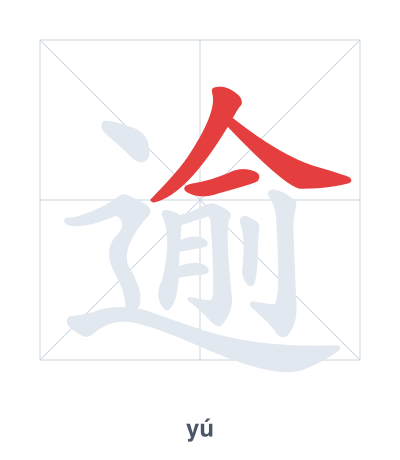
Open Hanzi Writer to see the animated stroke order and practice writing 逾 with real-time feedback.
The character 逾 (yú) is written with 12 strokes. Follow the standard Chinese stroke order: top to bottom, left to right, outside before inside. The radical 辶 is one of its key components.
Practice the correct stroke order with the Hanzi Writer app to see animated stroke-by-stroke guidance with real-time feedback.
逾 means to exceed; to surpass.
As an HSK Level 7 character, 逾 is an intermediate-level character.
逾 combines the radical 辶 (walk/action) with the phonetic component 俞 (yú). The radical indicates movement, and together they evoke the idea of walking beyond a boundary, hence 'to exceed' or 'to surpass.'
💡 Memory Tip: Imagine you (俞) take a walk (辶) that goes way beyond the usual path — you exceed the limit.
你的借书证逾期了。
nǐ de jiè shū zhèng yú qī le
Your library card has expired.
困难是无法逾越的。
kùn nán shì wú fǎ yú yuè de
The difficulty is insurmountable.
参加人数逾百。
cān jiā rén shù yú bǎi
The number of participants exceeded one hundred.
Open Hanzi Writer to see the animated stroke order and practice writing 逾 with real-time feedback.
✨ Animated stroke order · Handwriting recognition · HSK-graded practice · Free to use
逾 is composed of the radical 辶 (walking/ movement) on the left and the phonetic component 俞 (yú) on the right. The 辶 radical suggests movement or passing, while 俞 gives the sound — together they create the idea of "walking beyond" or exceeding a limit.