允 (yǔn) means "to permit; to allow; fair" in Chinese. It has 4 strokes with the radical 儿, and is HSK Level 6.
Rated 2.4/5 in difficulty (moderate).
Harder than 2% of HSK Level 6 characters.
Appears in 3+ common words including 允许 (yǔn xǔ), 允诺 (yǔn nuò), 公允 (gōng yǔn).
Hanzi Writer's stroke validation shows learners typically need 5-8 attempts to write 允 with correct proportion and order.
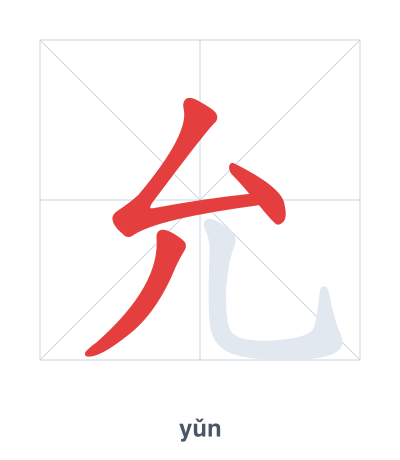
Open Hanzi Writer to see the animated stroke order and practice writing 允 with real-time feedback.
The character 允 (yǔn) is written with 4 strokes. Follow the standard Chinese stroke order: top to bottom, left to right, outside before inside. The radical 儿 is one of its key components.
Practice the correct stroke order with the Hanzi Writer app to see animated stroke-by-stroke guidance with real-time feedback.
允 means to permit; to allow; fair.
As an HSK Level 6 character, 允 is an intermediate-level character.
允 originally depicted a person (儿) with a seal or mark of approval above, symbolizing permission or agreement. Over time, the top component simplified to represent a nod or gesture of consent, linking the visual form to the idea of allowing or being fair.
💡 Memory Tip: Picture a person (儿) with a checkmark (the top part) over their head, signaling 'yes, you are permitted.'
老师允许我走。
lǎo shī yǔn xǔ wǒ zǒu
The teacher allowed me to leave.
他允诺了要求。
tā yǔn nuò le yāo qiú
He agreed to the request.
他的评价公允。
tā de píng jià gōng yǔn
His evaluation is fair.
Open Hanzi Writer to see the animated stroke order and practice writing 允 with real-time feedback.
✨ Animated stroke order · Handwriting recognition · HSK-graded practice · Free to use
允 is made of the top part 厶 (a bent shape) and the bottom radical 儿 (legs). This combination may suggest a person bowing or bending to show agreement, reflecting the meanings of permission and fairness. The radical 儿 indicates a person, while the top part adds the idea of yielding or consent.