兄 (xiōng) means "elder brother" in Chinese. It has 5 strokes with the radical 儿, and is HSK Level 4.
Rated 2.7/5 in difficulty (moderate).
Harder than 5% of HSK Level 4 characters.
Appears in 3+ common words including 兄弟 (xiōng dì), 兄长 (xiōng zhǎng), 堂兄 (táng xiōng).
Hanzi Writer's stroke validation shows learners typically need 5-8 attempts to write 兄 with correct proportion and order.
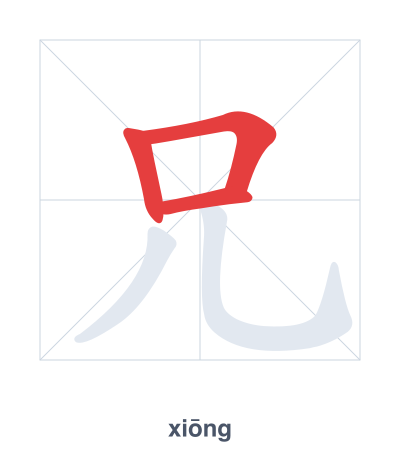
Open Hanzi Writer to see the animated stroke order and practice writing 兄 with real-time feedback.
The character 兄 (xiōng) is written with 5 strokes. Follow the standard Chinese stroke order: top to bottom, left to right, outside before inside. The radical 儿 is one of its key components.
Practice the correct stroke order with the Hanzi Writer app to see animated stroke-by-stroke guidance with real-time feedback.
兄 means elder brother.
As an HSK Level 4 character, 兄 is an intermediate-level character.
兄 is a compound of 口 (mouth) on top of 儿 (person), symbolizing an elder brother who speaks with authority. The ancient form shows a person with a prominent mouth, indicating the role of an older sibling who gives guidance or orders.
💡 Memory Tip: Picture an elder brother (儿) with a big mouth (口) bossing you around.
他有三个兄弟。
tā yǒu sān gè xiōng dì
He has three brothers.
他是我的兄长。
tā shì wǒ de xiōng zhǎng
He is my elder brother.
堂兄比我大两岁。
táng xiōng bǐ wǒ dà liǎng suì
My older male cousin is two years older than me.
Open Hanzi Writer to see the animated stroke order and practice writing 兄 with real-time feedback.
✨ Animated stroke order · Handwriting recognition · HSK-graded practice · Free to use
兄 is composed of a mouth (口) on top and legs (儿) below. This structure suggests an elder brother who stands tall and gives orders or speaks with authority.