许 (xǔ) means "To allow / To promise / Maybe" in Chinese. It has 6 strokes with the radical 讠, and is HSK Level 2.
Rated 2.4/5 in difficulty (moderate).
Harder than 22% of HSK Level 2 characters.
Appears in 3+ common words including 也许 (yě xǔ), 许多 (xǔ duō), 允许 (yǔn xǔ).
Hanzi Writer's stroke validation shows learners typically need 5-8 attempts to write 许 with correct proportion and order.
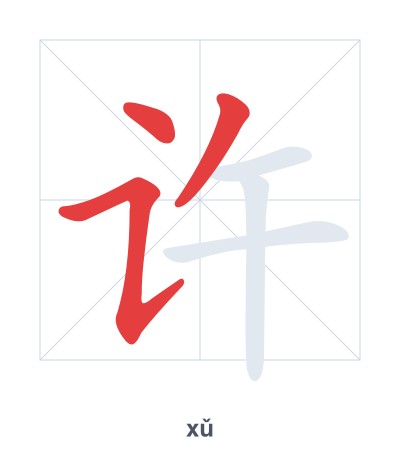
Open Hanzi Writer to see the animated stroke order and practice writing 许 with real-time feedback.
The character 许 (xǔ) is written with 6 strokes. Follow the standard Chinese stroke order: top to bottom, left to right, outside before inside. The radical 讠 is one of its key components.
Practice the correct stroke order with the Hanzi Writer app to see animated stroke-by-stroke guidance with real-time feedback.
许 means To allow / To promise / Maybe.
As an HSK Level 2 character, 许 is among the first characters beginners learn.
许 is a phono-semantic compound. The left side 讠 (言) represents speech or words, while the right side 午 (noon) provides the pronunciation xǔ. Together, they suggest the act of speaking a promise or granting permission with one's words.
💡 Memory Tip: Imagine someone at noon (午) saying (讠) 'I promise' to allow you a break from work.
他也许不来了。
tā yě xǔ bù lái le
He might not come.
这里有许多书。
zhè lǐ yǒu xǔ duō shū
There are many books here.
老师允许我回家。
lǎo shī yǔn xǔ wǒ huí jiā
The teacher allowed me to go home.
Open Hanzi Writer to see the animated stroke order and practice writing 许 with real-time feedback.
✨ Animated stroke order · Handwriting recognition · HSK-graded practice · Free to use
许 is made of the radical 讠 (speech) on the left and 午 (noon) on the right. The speech radical links the character to spoken words, so the meaning 'to allow' or 'to promise' comes from giving permission through speech.