兀 (wù) means "towering; upright" in Chinese. It has 3 strokes with the radical 儿.
Rated 2.2/5 in difficulty (moderate).
Appears in 3+ common words including 突兀 (tū wù), 兀自 (wù zì), 兀立 (wù lì).
Hanzi Writer's stroke validation shows learners typically need 5-8 attempts to write 兀 with correct proportion and order.
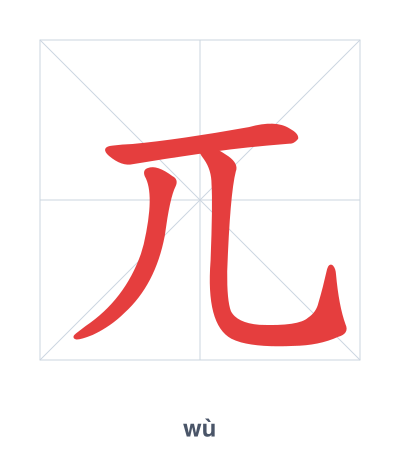
Open Hanzi Writer to see the animated stroke order and practice writing 兀 with real-time feedback.
The character 兀 (wù) is written with 3 strokes. Follow the standard Chinese stroke order: top to bottom, left to right, outside before inside. The radical 儿 is one of its key components.
Practice the correct stroke order with the Hanzi Writer app to see animated stroke-by-stroke guidance with real-time feedback.
兀 means towering; upright.
| Character | 兀 |
| Pinyin | wù (wu) |
| Meaning | towering; upright |
| Strokes | 3 |
| Radical | 儿 |
| Difficulty | 2.2/5 |
Originally a pictograph of a jagged mountain peak or a cut-off tree stump, the character 兀 depicts a vertical line rising above a horizontal ground line, conveying the idea of something towering and upright, yet truncated or blunt.
💡 Memory Tip: Picture a lone, upright tree stump with a single stubby branch poking out at the top—that's 兀, standing tall but cut off.
他的话很突兀。
tā de huà hěn tū wù
His words were very abrupt.
他兀自坐着。
tā wù zì zuò zhe
He sat there by himself.
大树兀立山顶。
dà shù wù lì shān dǐng
The large tree stands alone on the mountaintop.
Open Hanzi Writer to see the animated stroke order and practice writing 兀 with real-time feedback.
✨ Animated stroke order · Handwriting recognition · HSK-graded practice · Free to use
兀 consists of 儿 (legs) with a horizontal line on top. This shape suggests a person standing upright with arms outstretched, directly connecting to its meaning 'towering' or 'upright'.