克 (kè) means "gram, to overcome, to restrain" in Chinese. It has 7 strokes with the radical 儿, and is HSK Level 2.
Rated 2.7/5 in difficulty (moderate).
Harder than 25% of HSK Level 2 characters.
Appears in 3+ common words including 克 (kè), 克服 (kè fú), 巧克力 (qiǎo kè lì).
Hanzi Writer's stroke validation shows learners typically need 5-8 attempts to write 克 with correct proportion and order.
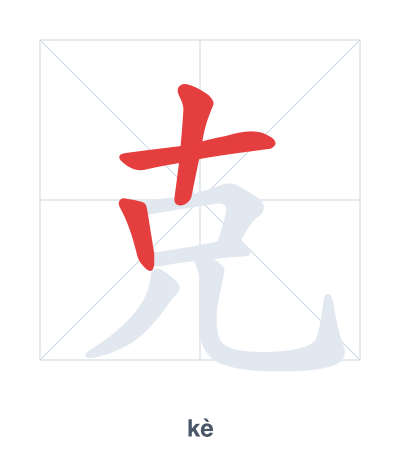
Open Hanzi Writer to see the animated stroke order and practice writing 克 with real-time feedback.
The character 克 (kè) is written with 7 strokes. Follow the standard Chinese stroke order: top to bottom, left to right, outside before inside. The radical 儿 is one of its key components.
Practice the correct stroke order with the Hanzi Writer app to see animated stroke-by-stroke guidance with real-time feedback.
克 means gram, to overcome, to restrain.
As an HSK Level 2 character, 克 is among the first characters beginners learn.
克 originally depicted a person (儿) holding a weapon or a heavy burden, symbolizing the ability to overcome or subdue an enemy. Over time, the character also came to represent a unit of weight (gram), possibly from the idea of 'carrying' a standard measure.
💡 Memory Tip: Picture a person (儿) in a martial pose under a heavy cross (十), shouting 'I will overcome!' — that's 克.
这袋糖有五百克。
zhè dài táng yǒu wǔ bǎi kè
This bag of sugar weighs 500 grams.
我们要克服困难。
wǒ men yào kè fú kùn nán
We must overcome difficulties.
我喜欢吃巧克力。
wǒ xǐ huān chī qiǎo kè lì
I like eating chocolate.
Open Hanzi Writer to see the animated stroke order and practice writing 克 with real-time feedback.
✨ Animated stroke order · Handwriting recognition · HSK-graded practice · Free to use
克 is made of 古 (ancient) on top and 儿 (legs) below. The 儿 component suggests a person, and together with 古 it implies overcoming old or difficult things. This structure helps explain the meaning 'to overcome' or 'to restrain'.