援 (yuán) means "to help; to cite" in Chinese. It has 12 strokes with the radical 扌, and is HSK Level 6.
Rated 4.2/5 in difficulty (advanced).
Harder than 65% of HSK Level 6 characters.
Appears in 3+ common words including 支援 (zhī yuán), 援助 (yuán zhù), 援引 (yuán yǐn).
Due to its 12 strokes, Hanzi Writer's error detection shows 援 requires focused practice — most learners need 10+ attempts for consistent accuracy.
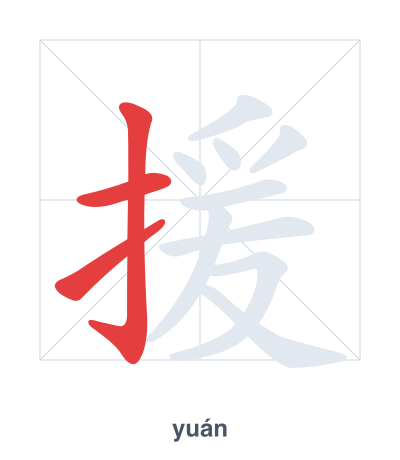
Open Hanzi Writer to see the animated stroke order and practice writing 援 with real-time feedback.
The character 援 (yuán) is written with 12 strokes. Follow the standard Chinese stroke order: top to bottom, left to right, outside before inside. The radical 扌 is one of its key components.
Practice the correct stroke order with the Hanzi Writer app to see animated stroke-by-stroke guidance with real-time feedback.
援 means to help; to cite.
As an HSK Level 6 character, 援 is an intermediate-level character.
援 is a phono-semantic compound where the left radical 扌 (hand) indicates an action of pulling or helping, and the right component 爰 (yuán) originally depicted two hands pulling a rope, providing both phonetic and semantic hints. The combination creates the idea of extending a hand to offer support or assistance.
💡 Memory Tip: Imagine a hand (扌) reaching out to grab a friend who is slipping off a cliff, with the shape on the right (爰) looking like a rope they're both holding.
我们去支援灾区。
wǒ men qù zhī yuán zāi qū
Let's go support the disaster area.
得到国际援助。
dé dào guó jì yuán zhù
To receive international aid.
援引法律条文。
yuán yǐn fǎ lǜ tiáo wén
Cite legal provisions.
Open Hanzi Writer to see the animated stroke order and practice writing 援 with real-time feedback.
✨ Animated stroke order · Handwriting recognition · HSK-graded practice · Free to use
The character 援 consists of the hand radical 扌 on the left and the phonetic component 爰 on the right. The hand radical shows that the character involves an action done with the hand, while 爰 originally depicted two hands pulling, reinforcing the idea of reaching out to help or cite.