引 (yǐn) means "to lead, pull, or quote" in Chinese. It has 4 strokes with the radical 弓, and is HSK Level 4.
Rated 2.7/5 in difficulty (moderate).
Harder than 6% of HSK Level 4 characters.
Appears in 3+ common words including 吸引 (xī yǐn), 引起 (yǐn qǐ), 引用 (yǐn yòng).
Hanzi Writer's stroke validation shows learners typically need 5-8 attempts to write 引 with correct proportion and order.
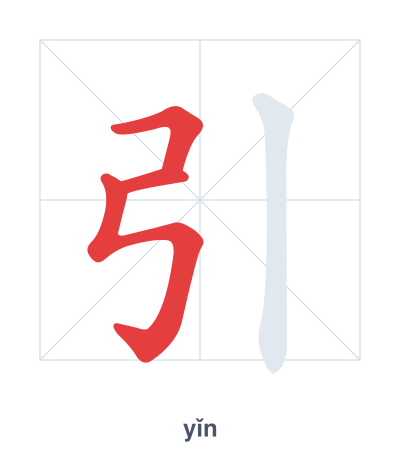
Open Hanzi Writer to see the animated stroke order and practice writing 引 with real-time feedback.
The character 引 (yǐn) is written with 4 strokes. Follow the standard Chinese stroke order: top to bottom, left to right, outside before inside. The radical 弓 is one of its key components.
Practice the correct stroke order with the Hanzi Writer app to see animated stroke-by-stroke guidance with real-time feedback.
引 means to lead, pull, or quote.
As an HSK Level 4 character, 引 is an intermediate-level character.
引 is a compound of 弓 (bow) and a vertical stroke representing the bowstring being drawn back, showing the action of pulling the bow—hence 'to pull' or 'to lead'. Later it extended to mean 'to quote', like drawing words from a source.
💡 Memory Tip: Imagine pulling a bow (弓) with a string (丨) to lead an arrow toward the target.
这个表演很吸引人。
zhè ge biǎo yǎn hěn xī yǐn rén
This performance is very engaging.
这件事引起了讨论。
zhè jiàn shì yǐn qǐ le tǎo lùn
This matter sparked a discussion.
请引用这篇文章的话。
qǐng yǐn yòng zhè piān wén zhāng de huà
Please quote from this article.
Open Hanzi Writer to see the animated stroke order and practice writing 引 with real-time feedback.
✨ Animated stroke order · Handwriting recognition · HSK-graded practice · Free to use
The character 引 combines the radical 弓 (bow) on the left and a small vertical line like a pull mark on the right. The bow represents pulling or drawing, and the line suggests the action of leading or stretching something, which together convey the idea of leading, pulling, or quoting.