愉 (yú) means "pleasant" in Chinese. It has 12 strokes with the radical 忄, and is HSK Level 6.
Rated 4.2/5 in difficulty (advanced).
Harder than 61% of HSK Level 6 characters.
Appears in 3+ common words including 愉快 (yú kuài), 愉悦 (yú yuè), 欢愉 (huān yú).
Due to its 12 strokes, Hanzi Writer's error detection shows 愉 requires focused practice — most learners need 10+ attempts for consistent accuracy.
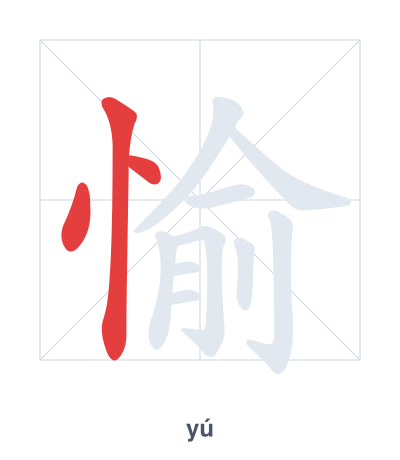
Open Hanzi Writer to see the animated stroke order and practice writing 愉 with real-time feedback.
The character 愉 (yú) is written with 12 strokes. Follow the standard Chinese stroke order: top to bottom, left to right, outside before inside. The radical 忄 is one of its key components.
Practice the correct stroke order with the Hanzi Writer app to see animated stroke-by-stroke guidance with real-time feedback.
愉 means pleasant.
As an HSK Level 6 character, 愉 is an intermediate-level character.
愉 combines the heart radical (忄), indicating emotion, with the phonetic component 俞 (yú). Together they convey a feeling of pleasure or joy, as the heart experiences a pleasant state.
💡 Memory Tip: Picture a heart (忄) enjoying a relaxing boat ride under a glowing moon (俞) — that peaceful joy is 愉.
祝你周末愉快!
zhù nǐ zhōu mò yú kuài
Have a great weekend!
音乐让人心情愉悦。
yīn yuè ràng rén xīn qíng yú yuè
Music makes people feel happy and pleasant.
这是一个欢愉的时刻。
zhè shì yí gè huān yú de shí kè
This is a joyful moment.
Open Hanzi Writer to see the animated stroke order and practice writing 愉 with real-time feedback.
✨ Animated stroke order · Handwriting recognition · HSK-graded practice · Free to use
愉 has the heart radical 忄 on the left, which shows the character relates to emotions or mood. The right part 俞 provides the sound "yú" and also suggests the idea of passing through smoothly, so together they create the feeling of pleasantness.