悦 (yuè) means "pleased" in Chinese. It has 10 strokes with the radical 忄, and is HSK Level 7.
Rated 4.2/5 in difficulty (advanced).
Harder than 55% of HSK Level 7 characters.
Appears in 3+ common words including 喜悦 (xǐ yuè), 悦耳 (yuè ěr), 悦目 (yuè mù).
Due to its 10 strokes, Hanzi Writer's error detection shows 悦 requires focused practice — most learners need 10+ attempts for consistent accuracy.
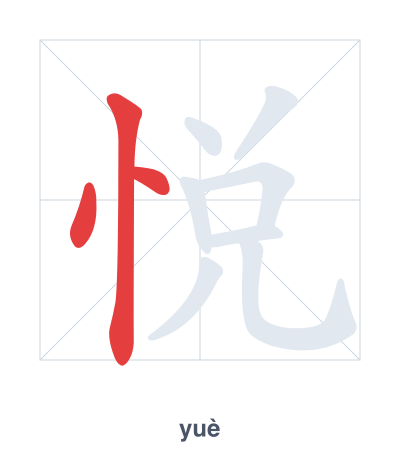
Open Hanzi Writer to see the animated stroke order and practice writing 悦 with real-time feedback.
The character 悦 (yuè) is written with 10 strokes. Follow the standard Chinese stroke order: top to bottom, left to right, outside before inside. The radical 忄 is one of its key components.
Practice the correct stroke order with the Hanzi Writer app to see animated stroke-by-stroke guidance with real-time feedback.
悦 means pleased.
As an HSK Level 7 character, 悦 is an intermediate-level character.
悦 combines the heart radical (忄) with 兑 (duì, 'exchange'), suggesting a heart that opens up or exchanges emotions—originally meaning 'joyful' or 'pleased'. The phonetic component 兑 shows a person speaking or exchanging, reinforcing the idea of a heart expressing delight.
💡 Memory Tip: Picture a delighted heart (忄) unwrapping a gift (兑) and exchanging smiles—pure pleasure!
脸上充满了喜悦。
liǎn shàng chōng mǎn le xǐ yuè
The face is full of joy.
音乐非常悦耳。
yīn yuè fēi cháng yuè ěr
The music is very pleasing to the ear.
这里的景色很悦目。
zhè lǐ de jǐng sè hěn yuè mù
The scenery here is pleasing to the eye.
Open Hanzi Writer to see the animated stroke order and practice writing 悦 with real-time feedback.
✨ Animated stroke order · Handwriting recognition · HSK-graded practice · Free to use
The left side is the heart radical 忄, which connects to emotions. The right side is 兑 (duì), which gives the sound and suggests the idea of exchange or satisfaction. Together, the character means 'pleased' — a feeling of the heart being satisfied.