仌 (bīng) means "Ice (ancient form of 冰)." in Chinese. It has 4 strokes with the radical 人.
Rated 2.4/5 in difficulty (moderate).
Appears in 3+ common words including 仌字 (bīng zì), 仌部 (bīng bù), 寒仌 (hán bīng).
Hanzi Writer's stroke validation shows learners typically need 5-8 attempts to write 仌 with correct proportion and order.
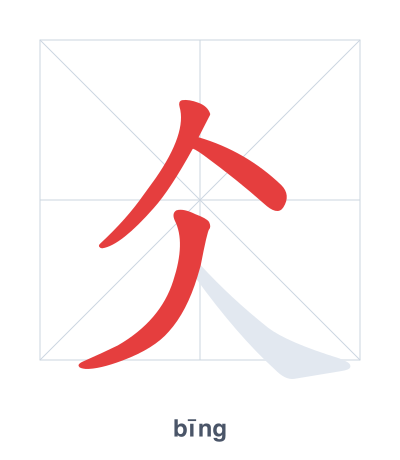
Open Hanzi Writer to see the animated stroke order and practice writing 仌 with real-time feedback.
The character 仌 (bīng) is written with 4 strokes. Follow the standard Chinese stroke order: top to bottom, left to right, outside before inside. The radical 人 is one of its key components.
Practice the correct stroke order with the Hanzi Writer app to see animated stroke-by-stroke guidance with real-time feedback.
仌 means Ice (ancient form of 冰)..
This ancient character depicts two ice crystals or cracks in ice, visually resembling stacked icicles or a frozen surface. It is the original pictograph for ice, before the water radical (氵) was later added to form 冰.
💡 Memory Tip: Picture two people (人) stacked on top of each other, frozen solid into a single block of ice.
仌是冰的古字。
bīng shì bīng de gǔ zì
'仌' is the ancient form of the character '冰'.
这个字属于仌部。
zhè ge zì shǔ yú bīng bù
This character belongs to the '仌' radical.
天气冷得像寒仌。
tiān qì lěng dé xiàng hán bīng
The weather is as cold as ice.
Open Hanzi Writer to see the animated stroke order and practice writing 仌 with real-time feedback.
✨ Animated stroke order · Handwriting recognition · HSK-graded practice · Free to use
仌 is made of two 人 (person) radicals stacked vertically. This double-person shape is believed to represent ice crystals or cracks in ice. The ancient meaning of 仌 is exactly the same as the modern character 冰 (ice).