亾 (wáng) means "To die or perish" in Chinese. It has 3 strokes with the radical 人.
Rated 2.2/5 in difficulty (moderate).
Appears in 3+ common words including 逃亾 (táo wáng), 亾命 (wáng mìng), 亾故 (wáng gù).
Hanzi Writer's stroke validation shows learners typically need 5-8 attempts to write 亾 with correct proportion and order.
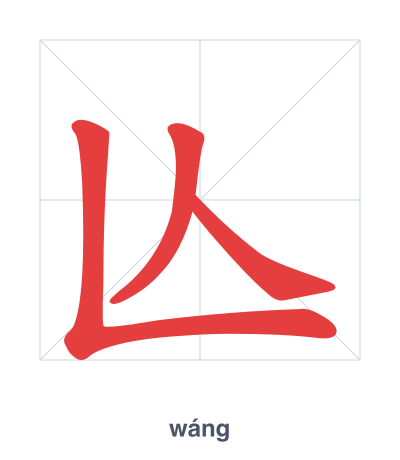
Open Hanzi Writer to see the animated stroke order and practice writing 亾 with real-time feedback.
The character 亾 (wáng) is written with 3 strokes. Follow the standard Chinese stroke order: top to bottom, left to right, outside before inside. The radical 人 is one of its key components.
Practice the correct stroke order with the Hanzi Writer app to see animated stroke-by-stroke guidance with real-time feedback.
亾 means To die or perish.
亾 is an ancient variant of 亡, combining the radical 人 (person) with a stroke suggesting concealment or disappearance. In oracle bone script, it depicted a person hiding in a cave or corner, symbolizing being lost or perishing. The form visually shows a person (人) with a marking that indicates their vanishing or death.
💡 Memory Tip: Picture a person (人) with a slash through them, representing their life being cut off as they perish.
他逃亾到了国外。
tā táo wáng dào le guó wài
He fled abroad.
他是一个亾命之徒。
tā shì yí gè wáng mìng zhī tú
He is a desperate criminal.
他的祖父已经亾故了。
tā de zǔ fù yǐ jīng wáng gù le
His grandfather has passed away.
Open Hanzi Writer to see the animated stroke order and practice writing 亾 with real-time feedback.
✨ Animated stroke order · Handwriting recognition · HSK-graded practice · Free to use
亾 is made up of the radical 人 (person) with an extra diagonal stroke crossing through it. The 人 represents a human being, and the stroke suggests cutting off or eliminating that person, symbolizing death or perishing.