腰 (yāo) means "waist" in Chinese. It has 13 strokes with the radical ⺼, and is HSK Level 4.
Rated 4.2/5 in difficulty (advanced).
Harder than 89% of HSK Level 4 characters.
Appears in 3+ common words including 腰疼 (yāo téng), 弯腰 (wān yāo), 裤腰 (kù yāo).
Due to its 13 strokes, Hanzi Writer's error detection shows 腰 requires focused practice — most learners need 10+ attempts for consistent accuracy.
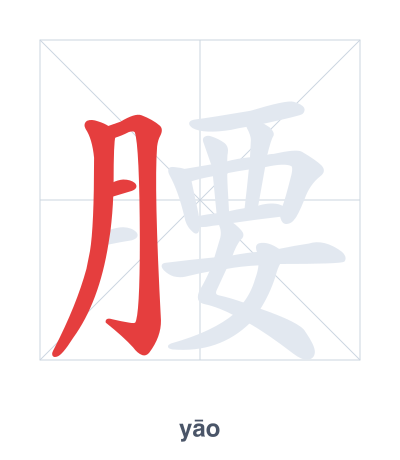
Open Hanzi Writer to see the animated stroke order and practice writing 腰 with real-time feedback.
The character 腰 (yāo) is written with 13 strokes. Follow the standard Chinese stroke order: top to bottom, left to right, outside before inside. The radical ⺼ is one of its key components.
Practice the correct stroke order with the Hanzi Writer app to see animated stroke-by-stroke guidance with real-time feedback.
腰 means waist.
As an HSK Level 4 character, 腰 is an intermediate-level character.
腰 combines the flesh radical ⺼ (meat/body part) with 要, which originally depicted a person with hands on their waist—the ancient form of 要 itself meant 'waist' before it was borrowed for 'to want'. Adding the meat radical specifies the physical body part, creating the current character for 'waist'.
💡 Memory Tip: Imagine a person (要) whose fleshy waist (⺼) is so important (要) that they always keep their hands on it.
我的腰疼了一天。
wǒ de yāo téng le yī tiān
My lower back has been hurting all day.
请不要弯腰拿东西。
qǐng bú yào wān yāo ná dōng xī
Please don't bend over to pick things up.
这条裤腰太紧了。
zhè tiáo kù yāo tài jǐn le
The waistband of these pants is too tight.
Open Hanzi Writer to see the animated stroke order and practice writing 腰 with real-time feedback.
✨ Animated stroke order · Handwriting recognition · HSK-graded practice · Free to use
The left side is the radical ⺼ (meat/flesh), which indicates body parts. The right side is 要 (yào, 'to want'), which gives the sound. Together, they form the character for 'waist', a part of the body.