Hanzi Writer

How to Write 盐 (yán) — Meaning “salt”

yán HSK Level 4 10 strokes Radical: 皿

盐 (yán) means "salt" in Chinese. It has 10 strokes with the radical 皿, and is HSK Level 4.

Rated 4.2/5 in difficulty (advanced).

Harder than 80% of HSK Level 4 characters.

Appears in 3+ common words including 食盐 (shí yán), 盐水 (yán shuǐ), 盐巴 (yán bā).

Due to its 10 strokes, Hanzi Writer's error detection shows 盐 requires focused practice — most learners need 10+ attempts for consistent accuracy.
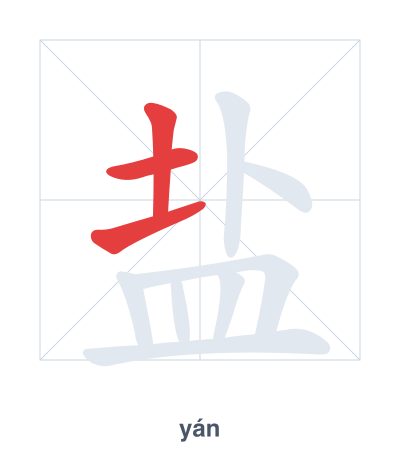
Stroke order practice for 盐 - yán

Practice Writing 盐 (yán)

Open Hanzi Writer to see the animated stroke order and practice writing 盐 with real-time feedback.

The character (yán) is written with 10 strokes. Follow the standard Chinese stroke order: top to bottom, left to right, outside before inside. The radical is one of its key components.

Practice the correct stroke order with the Hanzi Writer app to see animated stroke-by-stroke guidance with real-time feedback.

means salt.

As an HSK Level 4 character, is an intermediate-level character.

Character
Pinyinyán (yan)
Meaningsalt
Strokes10
Radical
HSK Level4
Difficulty4.2/5

The simplified character 盐 combines 皿 (a vessel) with a top part that originally derived from 鹽, where 鹵 depicted salt crystals and 监 provided pronunciation. The vessel radical indicates a container for storing or processing salt.

💡 Memory Tip: Picture a plate (皿) with a heap of salt (the top squiggles like 土 and 卜) that a chef sprinkles with a magic 'pinch' (卜) from the earth (土).

shí yán
table salt
yán shuǐ
salt water / brine
yán bā
salt (colloquial)

菜里的食盐放多了。

cài lǐ de shí yán fàng duō le

Too much salt was added to the dish.

请给我一杯盐水。

qǐng gěi wǒ yī bēi yán shuǐ

Please give me a glass of salt water.

这种盐巴很便宜。

zhè zhǒng yán bā hěn pián yi

This salt is very cheap.

Character Pinyin Strokes Radical
(current) yán 10
9
8
zhōng 9
Stroke order practice for 盐 - yán

Practice Writing 盐 (yán)

Open Hanzi Writer to see the animated stroke order and practice writing 盐 with real-time feedback.

✨ Animated stroke order · Handwriting recognition · HSK-graded practice · Free to use

Frequently Asked Questions about 盐

The top part 土 means "earth" or "soil," and the bottom part 皿 means "container" or "dish." Together, they suggest salt coming from the earth into a container, which connects to the character's meaning of "salt." However, note that the modern etymology is complex; the top part is actually a phonetic component, not directly meaning soil.

More HSK Level 4 Characters

Characters with Radical 皿

Other 10-Stroke Characters