盍 (hé) means "why not (classical Chinese)" in Chinese. It has 10 strokes with the radical 皿.
Rated 4.2/5 in difficulty (advanced).
Appears in 3+ common words including 盍各 (hé gè), 盍往 (hé wǎng), 盍归 (hé guī).
Due to its 10 strokes, Hanzi Writer's error detection shows 盍 requires focused practice — most learners need 10+ attempts for consistent accuracy.
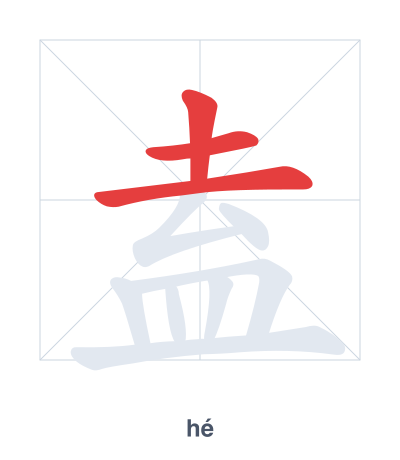
Open Hanzi Writer to see the animated stroke order and practice writing 盍 with real-time feedback.
The character 盍 (hé) is written with 10 strokes. Follow the standard Chinese stroke order: top to bottom, left to right, outside before inside. The radical 皿 is one of its key components.
Practice the correct stroke order with the Hanzi Writer app to see animated stroke-by-stroke guidance with real-time feedback.
盍 means why not (classical Chinese).
| Character | 盍 |
| Pinyin | hé (he) |
| Meaning | why not (classical Chinese) |
| Strokes | 10 |
| Radical | 皿 |
| Difficulty | 4.2/5 |
盍 originally depicted a lid (the top part, a variant of 去) covering a vessel (皿). Its original meaning was 'to cover,' but it was later borrowed in classical Chinese to represent the contraction 'why not' (何不).
💡 Memory Tip: Picture someone pointing at a dish (皿) and saying 'Why not go (去) get it?'
盍各言其志?
hé gè yán qí zhì
Why don't you each speak of your aspirations?
盍往观之?
hé wǎng guān zhī
Why not go and see?
盍归乎来?
hé guī hū lái
Why not come back?
Open Hanzi Writer to see the animated stroke order and practice writing 盍 with real-time feedback.
✨ Animated stroke order · Handwriting recognition · HSK-graded practice · Free to use
盍 is made of the radical 皿 (皿, meaning "bowl" or "container") on the bottom, and the upper part is 去 (qù, meaning "go" or "leave") but slightly modified. The idea is that something goes away from a bowl, so 盍 in classical Chinese means "why not"—as in asking why you don't do something.