盂 (yú) means "basin" in Chinese. It has 8 strokes with the radical 皿.
Rated 3.7/5 in difficulty (challenging).
Appears in 3+ common words including 痰盂 (tán yú), 水盂 (shuǐ yú), 钵盂 (bō yú).
Due to its 8 strokes, Hanzi Writer's error detection shows 盂 requires focused practice — most learners need 10+ attempts for consistent accuracy.
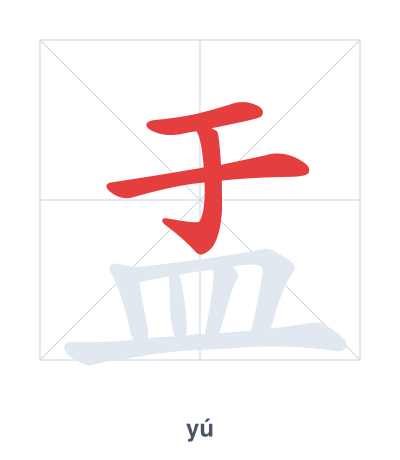
Open Hanzi Writer to see the animated stroke order and practice writing 盂 with real-time feedback.
The character 盂 (yú) is written with 8 strokes. Follow the standard Chinese stroke order: top to bottom, left to right, outside before inside. The radical 皿 is one of its key components.
Practice the correct stroke order with the Hanzi Writer app to see animated stroke-by-stroke guidance with real-time feedback.
盂 means basin.
| Character | 盂 |
| Pinyin | yú (yu) |
| Meaning | basin |
| Strokes | 8 |
| Radical | 皿 |
| Difficulty | 3.7/5 |
盂 combines the radical 皿 (a vessel or container) with 于, which provides the sound. Together, they depict a basin or bowl used for holding liquids or food, such as a washbasin or a rice bowl.
💡 Memory Tip: Picture a basin (皿) shaped like a U (from 于) where you wash your hands before meals.
房间里有个痰盂。
fáng jiān lǐ yǒu gè tán yú
There is a spittoon in the room.
书桌上放着水盂。
shū zhuō shàng fàng zhe shuǐ yú
A water pot is on the desk.
和尚手里拿着钵盂。
hé shàng shǒu lǐ ná zhe bō yú
The monk is holding an alms bowl in his hand.
Open Hanzi Writer to see the animated stroke order and practice writing 盂 with real-time feedback.
✨ Animated stroke order · Handwriting recognition · HSK-graded practice · Free to use
盂 is made of two parts: the upper part 于 (yú) gives a hint to the pronunciation, and the lower part 皿 (mǐn) means "container" or "dish." Together, they form a character meaning a basin or bowl-like vessel. This structure combines a sound component with a meaning component.