盈 (yíng) means "full" in Chinese. It has 9 strokes with the radical 皿, and is HSK Level 7.
Rated 4/5 in difficulty (challenging).
Harder than 43% of HSK Level 7 characters.
Appears in 3+ common words including 盈利 (yíng lì), 盈余 (yíng yú), 充盈 (chōng yíng).
Due to its 9 strokes, Hanzi Writer's error detection shows 盈 requires focused practice — most learners need 10+ attempts for consistent accuracy.
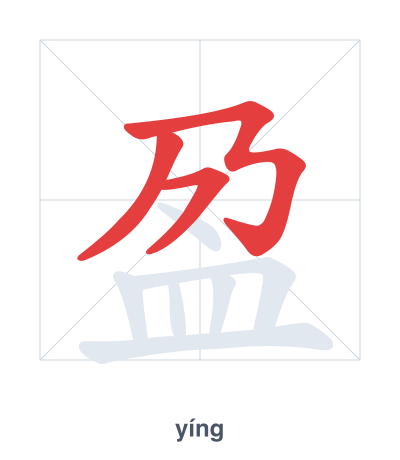
Open Hanzi Writer to see the animated stroke order and practice writing 盈 with real-time feedback.
The character 盈 (yíng) is written with 9 strokes. Follow the standard Chinese stroke order: top to bottom, left to right, outside before inside. The radical 皿 is one of its key components.
Practice the correct stroke order with the Hanzi Writer app to see animated stroke-by-stroke guidance with real-time feedback.
盈 means full.
As an HSK Level 7 character, 盈 is an intermediate-level character.
盈 combines 夃 (meaning 'to overflow' or 'profit') with 皿 (a vessel). The character depicts water or contents rising above the rim of a container, visually showing a state of being full to the point of spilling over.
💡 Memory Tip: Imagine a dish (皿) so full that the food piles up like a mountain (夃 resembling a mound) and starts spilling over the sides.
这家公司今年盈利了。
zhè jiā gōng sī jīn nián yíng lì le
This company made a profit this year.
我们的账户还有盈余。
wǒ men de zhàng hù hái yǒu yíng yú
Our account still has a surplus.
他的内心充盈着喜悦。
tā de nèi xīn chōng yíng zhe xǐ yuè
His heart is filled with joy.
Open Hanzi Writer to see the animated stroke order and practice writing 盈 with real-time feedback.
✨ Animated stroke order · Handwriting recognition · HSK-graded practice · Free to use
盈 is made of 乃 on top and 皿 (vessel) on bottom. 乃 suggests overflowing or abundance, while 皿 is a container; together they mean a vessel that is full to the brim, hence 'full' or 'abundant'.